
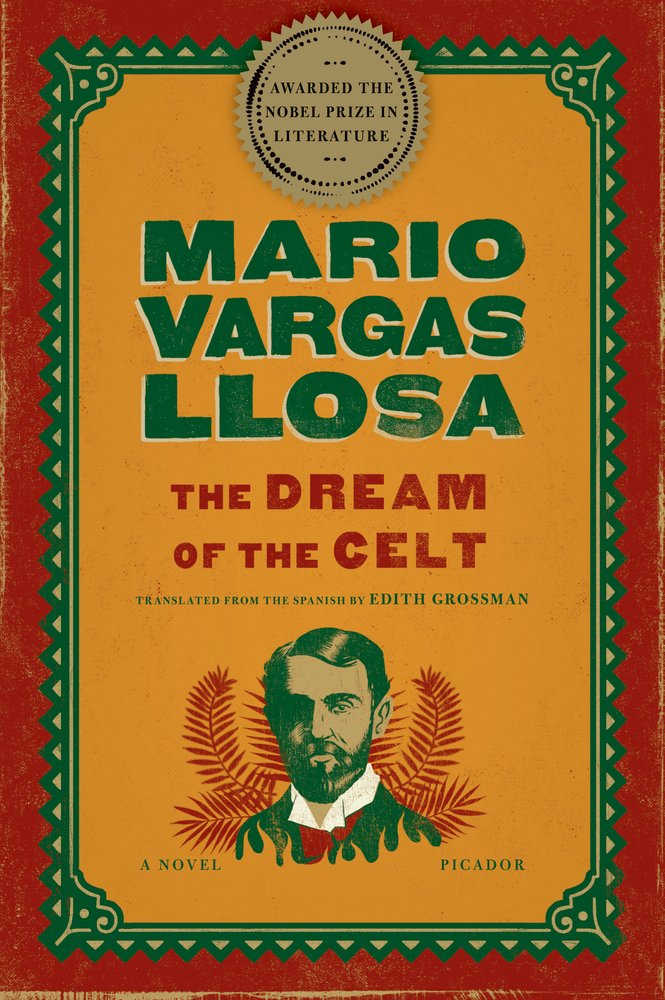
The Dream of the Celt: A Novel by Mario Vargas Llosa, translated from the original Spanish by Edith Grossman

http://jacketupload.macmillanusa.com/jackets/high_res/jpgs/9781250033321.jpgI prefer historical fiction to biography.  An individual seldom lives up to the mythology arises around celebrity.  I didn’t enjoy reading about F. Scott Fitzgerald’s descent into alcoholism, Edna St. Vincent Millay losing her identity in what some of her friends seem to have felt was an abusive marriage or Hemingway’s general pettiness.  Or worse, find out that in between those moments of brilliance (as in the case of P.D. Wodehouse, for example) the person I admired led a life that was otherwise only remarkable for its mundanity.  Yes, yes, I know – these expectations are unrealistic.  No one can reside on a pedestal.  But still, I prefer my heroes to remain heroic…  Or at the very  least to possess the dark glamor of an anti-hero.

Perhaps the most intriguing facet of  Roger Casement is that his supposed shortcomings, his blackened reputation, have for a long time overshadowed the good he did.  Here is a man spent his life as a passionate human rights activist.  Casement worked tirelessly and recklessly to bring to the public’s attention the horrors of King Leopold’s Congo.  Later, he would travel to Peru to confirm rumors of similar mistreatment and enslavement of the Putumayo Indians by the  Peruvian Amazon Company.   These atrocities were committed against two sets of indigenous peoples – in countries located 11,329.6 kilometers apart – for the same reason.  To fulfill the international demand for rubber.   For his work Casement would receive both induction into The Order of Michael & Saint George and a knighthood.

It was after his return from Peru that Casement’s  Irish Nationalism – an interest which had been developing over several years – moved towards radicalism.  He aligned himself with those who believed that “home rule”, the possibility of which was dangled before the Irish by the British Parliament like a carrot-on-a-stick, was not the answer.  He was convinced that only true way to gain Ireland’s independence was through an armed uprising.  But he also understood that Ireland would need a powerful ally if such an uprising was to succeed.  So, in the midst of WWI he traveled to Berlin and attempted to forge an alliance between Germany and Ireland.   He failed.  And this failure resulted in his imprisonment and execution as a traitor.

The Dream of the Celt is Mario Vargas Llosa’s first novel after winning the Nobel Prize in 2010.  It is remarkable for the compassion and humanity with which Llosa describes the life and death of Robert Casement.  He presents a complicated man who leaves the reader with mixed feelings.  Llosa’s Casement is a crusader – a zealot.  Whose tunnel vision in the name of a cause – Irish Nationalism – is a combination of pragmatism and naivety which left me squirming.  Pragmatic, in his attempts to seek an Irish alliance with the Kaiser’s Germany.  Naive because of his inability to anticipate the consequences of this act.  Many of his friends turned their backs on him (some who had sons fighting in the British army) when news of his trip to Berlin and the reasons for it became public.  As did the Irish soldiers he attempted to recruit from the German POW camps.

And then there were The Black Diaries – Casement’s private journals which were used by the British government to turn what little favorable public opinion that remained against him and ensure that clemency would be denied.  These journals, which contained lurid descriptions of sexual encounters, are now widely accepted as having been written by Casement (though there remains some disagreement as to where the line between fact and fantasy blurred).  They revealed Casement’s homosexuality to the world and destroyed what remained of his reputation.  Llosa deals with this in an Epilogue, which I recommend reading (even if you are not usually a reader of Forwards and Epilogues).

It took a long time for him [Robert Casement] to be admitted to the pantheon of the heroes of Irish independence.  The secretive campaign launched by British Intelligence to slander him, using fragments of his secret diaries, was successful.  It hasn’t completely dissipated even now: a gloomy aureole of homosexuality and pedophilia surrounded his image throughout all the twentieth century.  His figure discomfited his country because Ireland, until not many years ago, officially maintained an extremely harsh morality in which the mere suspicion of being a “sexual deviant” sank a person into ignominy and expelled him from public consideration…

With the revolution in customs, principally in the area of sexuality, in Ireland, the name of Casement gradually, though always with reluctance and prudery, began to clear a path as being accepted for what he was:  one of the great anticolonial fighters and defenders of human rights and indigenous cultures of his time, and a sacrificed combatant for the emancipation of Ireland.  Slowly his compatriots became resigned to accepting that a hero and martyr is not an abstract prototype or a model of perfection but a human being made of contradictions and contrasts, weakness and greatness, since a man, as José Enrique Rodó wrote, “is many men,” which means that angels and demons combine inextricably in his personality.

The Dream of the Celt is not a biography.  Llosa is not attempting to uncover the facts or even rehabilitate Casement’s reputation.  His goal is to present a rounded portrait of a man, and in that man to describe an Everyman.  Llosa is tackling the themes that the important authors will always return to:  memory, regret, life, death, human connection, a person’s capacity for greatness and the inevitable failures that come in attempting to reach it.

_______________________________________

A quick note on the English translation, by the legendary Edith Grossman, which has just won the International Latino Book Award for Best Fiction Translation.  It’s gorgeous.  The prose flows so easily that it’s difficult to believe that English isn’t the language of origin.  Elegant without being self-conscious:  this is Grossman’s signature.  She has the knack for understatement, as in the following passage (which remained with me after I finished The Dream of the Celt).   This is immediately after Casement learns that his private journals have been published and his secret revealed.

With an almost imperceptible movement of this head, the prisoner refused.  He turned immediately afterward, facing the door of the  visitor’s room.  With his chubby face the sheriff signaled the guard, who unbolted the door and opened it.  The return to his cell was interminable.  During his passage down the long hall with the rocklike walls of blackened red brick, he had the feeling that at any moment he might trip and fall facedown on those damp stones and not get up again.  When he reached the metal door of his cell, he remembered: on the day they brought him to Pentonville Prison, the sheriff had told him that, without exception, all the prisoners who occupied this cell had ended up on the gallows.

This wasn’t my first attempt at reading Mario Vargas Llosa, but The Dream of the Celt is the first novel of his I’ve managed to finish.  This is largely due to Edith Grossman’s wonderful translation.  If you’ve ever wondered how important the translator truly is to the success of a novel, I recommend picking up a few books by the same author, but translated by different translators.  The differences can be shocking.  Grossman lives up to her reputation (the “legendary” wasn’t a joke).  She’s translated five other works by Llosa – as well as the works of other important Spanish authors, including Gabriel García Márquez.

Publisher:  Picador, New York (2013)
ISBN:  978 1250 03332 1

Add to FacebookAdd to DiggAdd to Del.icio.usAdd to StumbleuponAdd to RedditAdd to BlinklistAdd to TwitterAdd to TechnoratiAdd to Yahoo BuzzAdd to Newsvine

Bare Facts – The Berlin-Baghdad Express: The Ottoman Empire & Germany’s Bid for World Power by Sean McMeekin

Welcome to Bare Facts: a new, monthly *crosses fingers* feature for 2013 which is all about non-fiction.  The books reviewed in Bare Facts are intended to help provide a historical, geographic and political context  – with subjects ranging from international history, politics, personalities on the world stage, religion, philosophy, etc.


BerlinBaghdadExpress
“The Great Game” is the term used for the 19th and early 20th century struggle between Russia & Great Britain for control of the Middle/Near East.  Sean McMeekin’s book, The Berlin-Baghdad Express, examines the period surrounding the first World War, when Germany made their play at the region through strengthening their relations with the Ottoman Empire and building a railroad that ran from Berlin to Baghdad.  You’ll want to keep a map at your elbow while reading this book.

A warning:  train and railroad enthusiasts should contain their enthusiast because the title is somewhat misleading.  It refers to McMeekin’s premise that Germany & the Central Powers’ failure in the region was in a large part the result of their inability, due to geography and political conflicts, to build a continuous rail network between Berlin and Baghdad.  Unfortunately, as I just demonstrated, you don’t need 400+ pages to make this point. So, while some discussion happens at the beginning and the end of the book, the bulk of The Berlin-Baghdad Express: The Ottoman Empire & Germany’s Bid for World Power focuses on the complicated (and often preposterous) German machinations to incite a global jihad.

The Porte – the governing body of the Ottoman Empire – had recently been taken over by a group known as the “Young Turks”.  This new, progressive government attempted to put the nation on a more secular path.  In an attempt to reach his goal, the “sick old man of Europe” decided to throw his lot in with the Central Powers.  And while it played the board surprisingly well, the Ottoman Empire was in a tenuous situation from which it never managed to escape.  Germany and the British actively courted the Porte with gold and weapons, but Russia was a constant threat in the East.  The reality was that the “sick old man” was never viewed as more than a pawn in the Great Game played by these three powers.  Albeit a well-payed pawn.  (I particularly like this cartoon from Punch Magazine, showing the Kaiser loading a cannon with a shell representing Turkey – which pretty much shows the situation Turkey found themselves in).  WWI Cartoon

But what a game it was!  Berlin-Baghdad Express is filled with fascinating historical minutiae – the kind of spy vs. spy drama seemingly more suited to a John LeCarre novel than something published by Harvard University Press.  (McMeekin is all too aware of the genre element in his story and makes frequent references the novel Greenmantle by John Buchan).   No author could ask for a more romantic period or place – this was the time of Lawrence of Arabia and the setting for the Indiana Jones films.  A colorful cast of whirling dervishes, sheiks and sultans, Bedouins and dragoman, archeologists and Orientalists, traipse across the page.  At one point even “the Duke of Westminster made an appearance, commanding a ‘Light Armoured Car Brigade’ which included ‘six armoured Rolls-Royces mounted with machine guns’.

The failure of Germany rested on more than an incomplete rail system.  Despite having what they thought were the necessary men on the ground, Orientalists who (like Lawrence) had supposedly “gone native”, there were still large holes in German understanding of how the Muslim religion operated.  Only after it was too late did they understand the subtle but important differences and delicate relationships between different sects (Shia & Sunni), tribes and – perhaps most importantly – between Arabs & Turks.  The following extract is wordy, taken from two separate chapters of the book, but it eloquently explains the opportunistic way in which the European powers attempted to manipulate their supposed allies.  That the Germans wore rose-colored glasses is an almost comical understatement of the situation.

Despite his own holy war promises to Kaiser Wilhelm, in October even Enver had cold feet about issuing a full-on global jihad declaration, for fear the Germans, too, would be ensnared if it were taken literally.  The result was a ‘proclamation of holy war against all Europeans with the exceptions of Austrians, Hungarians, and Germans’ – was something of a mess, neither uncompromising enough for the Germans, nor theologically proper enough to satisfy Muslim clerics.  Read literally, moreover, it meant that citizens of neutral countries could be targeted.  So, too, could Belgians, who were specifically named in Ottoman jihad decrees, and Serbians.  By contrasts, US citizens resident in Turkey were specially exempted, along with employees of American missionary colleges….

…Considering how much blood, arms and treasure the Germans had invested in summoning up the ancient spirit of Islamic holy war to bring down the Entente empires, one can understand the creeping sense of disappointment for each successive failure of Oppenheim’s jihad to ignite.  But a true scholar of Islam could have told the Germans exactly what to expect.  As infidels themselves, the Germans could hardly summon up a holy war on their own.  In terms of Islamic jurisprudence, the notion of selective jihad against some, but not all, Christians, as we saw in chapter 6 above, is nonsensical.  On the other hand, the practice of infidels paying for protection – as the Germans, in effect, were doing each time they asked Muslims to spare them while attacking other Christians – is firmly established in Islamic law.  The theological grounds for this jizya, or compulsory tax paid by non-Muslims, is explained clearly in the Koran, Sura 9:29: ‘Fight those who believe not in Allah nor the Last Day, nor hold that forbidden with hath been forbidden by Allah and His Messenger, nor acknowledge the religion of Truth (even if they are) of the People of the Book [i.e. Christians and Jews], until they pay the Jizya with willing submission, and feel themselves subdued’ (emphasis added).  German requests for Islamic fatvas and jihadi uprisings against the Entente powers may not have been conceived in Berlin as jizya offerings, but that may have been just how they were interpreted by many Turkish, Arab and Persian imams and clerics.

The product of ignorance?  A lot of gold was spent in the Middle East during the period between 1914-1915 to negligible effect.

The book’s final chapters carefully explain the context and future repercussions of these events.  Because WWII is essentially the lynchpin of 20th century history, McMeekin takes the time to discuss how the German’s cynical attempt to incite a targeted jihad was a precursor to the anti-Semitism of not only the Holocaust, but the attitudes that exist in the Middle East to this day.  He shows how Zionism, a movement which actually began in Germany, was embraced/co-opted by the British.  He deals with the Russian situation: where the Central Powers successful nurturing of the Bolshevik Revolution produced results beyond their wildest dreams.  Thankfully, The Berlin-Baghdad Express goes far beyond how for lack of proper train schedules a war was lost.

Publisher:  The Belknap Press of Harvard University Press, Cambridge (2010)
ISBN:  978 0 674 05739 5

Add to FacebookAdd to DiggAdd to Del.icio.usAdd to StumbleuponAdd to RedditAdd to BlinklistAdd to TwitterAdd to TechnoratiAdd to Yahoo BuzzAdd to Newsvine