 From the opening pages of his newest book one gets the feeling that Umberto Eco wanted to create his own version of The Da Vinci Code. Like that novel The Prague Cemetery is compulsively readable. The prose is wonderfully playful – Eco at his best. It dances along while pulling readers happily behind… almost against their will. Because Eco isn’t writing about the Knights Templar or Catholic mysteries. Instead he invites us to take a front row seat at the founding of modern antisemitism.
Obviously, this shouldn’t make for the most enjoyable reading experience. Yet somehow (as uncomfortable as it is to admit) it does. The Prague Cemetery plays at being a swashbuckling adventure story told from the perspective of the evil Svengali: one Captain Simone Simonini. Eco layers in conspiracy theories and enough historical references to keep any Wikipedia junkie employed for hours.
Umberto Eco has deliberately created this sugar-coated pill. He writes in the introduction that he expects The Prague Cemetery to find two kinds of readers. The first, the Dan Brown aficionado, will lack historical knowledge but “should gain a certain sadistic satisfaction from what will seem a perverse invention”. The second reader will have the historical background to understand that he, Eco, is telling the truth. And “the fact that history can be quite so devious may cause this reader’s brow to become lightly beaded with sweat. He will look anxiously behind him, switch on the lights, and suspect that these things could happen again today. In fact, they may be happening in that very moment. And he will think, as I do: ‘They are among us…’ “
The novel’s plot is fairly complicated. It employs three narrators, all speaking in the first person. The main protagonist, Captain Simone Simonini is an expert forger, a spy, and an altogether shady character. Much of the book is his personal diary. He is writing the story of his life in an attempt to get at the root cause of the sudden lapses in memory he has been experiencing. He’s been, in effect, loosing time (see dissociative amnesia).
During Simonini’s episodes our second narrator – an Abbé Dalla Piccolo who also suffers from attacks of amnesia which seem to alternate with Simonini’s – emerges. The Abbé has been leaving messages in Simonini’s diary and filling in the blanks. The two men communicate with each other through their writings in a desperate attempt to piece together their common history and discover the reason for their shared memory loss. (The third narrator refers to himself as, simply, “the narrator”. His sole function is to help the reader make sense of Eco’s brilliantly complicated plot.)
Despite the fact that he has had some remarkable and fascinating adventures, Captain Simonini is repulsive. Eco has famously stated that this man (the only truly fictional character he claims the novel contains) was created to be “the most cynical and disagreeable [character] in all the history of literature”. Simonini is defined by a hatred which he does not confine exclusively to the Jewish race, though they do bear the greater part of it. But, make no mistake, no one is safe. In the early chapters he goes on a tirade bashing the Italians, Spanish, French, English, Prussians and women – the entire gender. We’re told that “his dislike of others induced him to make the best of his own company”. At points it borders on the darkly comedic.
Which is a large part of why The Prague Cemetery manages to entertain. Simonini (and his motley underground network) are farcical… and Eco doesn’t hesitate to play them for all they’re worth. The individual plot points – “the fact that history can be quite so devious” – are stunning yet believable. But by stacking these episodes precariously one on top of another they appear ridiculous and incredible. The author forms them into a wobbling tower of implications (the usual foundation of conspiracy theories) and proves how flimsy the supporting evidence is. This is important because even though the unifying figure of Simonini is a complete work of fiction, the events he describes and the conspiracy constructed out of them is not.
Simonini traces his hatred of the Jewish race back to childhood, where he learned it at the knee of his grandfather. The grandfather took his own antisemitism so far as to write a letter to the Jesuit Priest Abbé Augustin Barruel (the letter and both men actually existed) claiming to know details of a conspiracy by the Jews to take over the world. This becomes the foundation of a forged document that Simonini will return to and re-work again and again throughout the course of his life, referring to it as “the meeting at the Prague Cemetery”.
He develops his document through plagiarism, conspiracy theory and over-the-top melodrama. He describes his life’s work as “Better than Dumas, and better than the Jesuits”. Eventually it will evolve into something horrible – The Protocols of the Elders of Zion – a forgery that is the cornerstone of antisemitism in the 20th century.
I went back to the library, but this time I was in Paris, where I could find much more than in Turin, and here I found more pictures of the Prague cemetery. It has been there since the Middle Ages. The burial ground could not be extended beyond the permitted area, and so more graves were added over the centuries, one on top of the other, until there were perhaps a hundred thousand bodies, and the number of gravestones grew, until one was almost touching the next, covered by fronds of elder and without any portraits to decorate them, since the Jews have a terror of images. In their fascination with the site, engravers had perhaps exaggerated their depiction of the stones, which mushroomed from the ground like moorland shrubs bent back by the winds – the space seemed like the gaping mouth of a gap-toothed old witch. But thanks to some of the more imaginative engravers who had portrayed it in moonlight, I immediately saw how I could make use of that unearthly atmosphere, placing – among the stones that looked like paving slabs upended by some subterranean tumult – the bent, cloaked and hooded figures of rabbis…
The antisemitism expressed by the characters in this book can make for uncomfortable reading. Captain Simonini speaks with a casual racism that, while true to his character, is 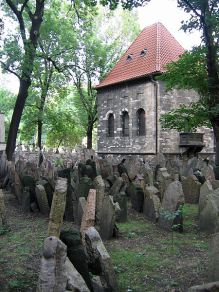
still offensive. Worse still are some of the illustrations, racist caricatures of Jewish men that caused me to cringe and quickly turn the page (in the interview I link below Eco describes being embarrassed by them). But, while The Prague Cemetery is at times deeply unsettling, it is also an amazing achievement. A book that encompasses a wide arc of 20th century history. From Garibaldi’s campaigns in Italy, Alexander Dumas’ novels, the Dreyfus Affair, The Franco-Prussian War, Jesuits, Masons, the intrigues of the Catholic Church, Satanic rituals, the discoveries of Sigmund Freud and the foreshadowing of Hitler’s final solution (listed with no apparent order in mind) – Umberto Eco manages to weave it all into an intelligent, challenging story that will hold his reader’s attention until the very last page.
Note: The Paris Review published a wonderful interview (November 15, 2011) with Umberto Eco on The Prague Cemetery. It answered many of my questions in a surprisingly short space and I highly recommend it to anyone reading the novel.
Publisher: Houghton Mifflin Harcourt, New York (2011)
ISBN: 978 0 54757 753 1



 My most recent audiobook download from Iambik.com is Rebecca Pawel’s novel Death of a Nationalist. Set in 1939, in the early days of Franco’s Spain, it’s a murder mystery that doesn’t shy away from the complexities of history.


