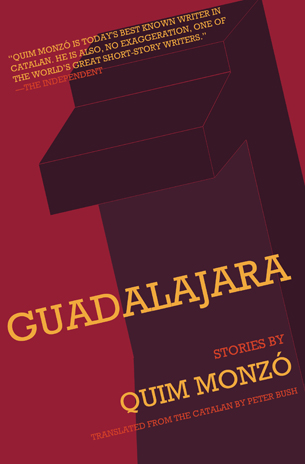
 Quim Monzó’s (a Catalan author) book, Guadalajara, contains 14 short stories – divided into five parts and grouped according to common themes. Unusual care seems to have been taken in considering the order they are arranged in. It’s a stunning collection – and one of my favorite books of 2011.
The comparisons that immediately come to mind are Jorge Luis Borges’ Labyrinths or Italo Calvino’s Invisible Cities. All three collections contain densely written stories, with plots constructed around abstract ideas rather than narrative action. All three authors write clear, almost elegant, sentences and tell their stories in formal, polite tones. But Monzó’s writing also reminds me of the (unlikely) American author: John Cheever. Cheever, whose stories unfold slowly. His carefully crafted plots begin in one place or with one idea, but morph and evolve into somewhere (something) entirely unexpected. The classic Cheever example being The Swimmer, in which our perception of the main character changes in harmony with the landscape he travels through.
Another trait that Cheever & Monzó share is their fondness of what my high school English teacher liked to call “little epiphanies” - subtle and startling moments of revelation – ideas that overtake the story and its reader. Think of them as a refined, thinking-man’s version of the now ubiquitous plot twist.
Guadalajara opens with a stand alone tale about a boy who refuses to take part in a gruesome family tradition. When a child reaches the age of nine the ring finger on his/her left hand is cut off. What begins as a standard (if somewhat macabre) coming of age story, Family Life becomes more tangled as the consequences and repercussions of the boy’s decision ripple out. It is one of the few times Monzó sticks with a traditional story structure, one with an easily identifiable beginning, middle and end. But even here, the final line starts to unravel the logic.
She is pretty and has a lovely smile and a lock of brown hair that hides half of her face, the way some women hide a glass eye.
The next group of stories will be familiar to most readers. Old favorites which have been revised and reinvented. Outside the Gates of Troy presents an alternative version of the fall of Troy – one in which the Trojans leave the wooden horse outside the city gates with the Greeks trapped, slowly dying, inside. Gregor is The Metamorphosis turned inside out, the cockroach becoming a teenage boy. A Hunger and Thirst for Justice transforms the legend of Robin Hood into an indictment against the redistribution of wealth.
Parts 3 & 4 contain my personal favorites from the collection. In these, Monzó’s characters travel in a series of continuous loops, always returning to the beginning – constantly reinventing and revising the future (the premise of this section is anticipated by its predecessor). Like the Ouroboros: the serpent that eats its own tail – these stories enact seemingly endless cycles of renewal & re-creation.
And so, a man & woman (Life Is So Short) tentatively start & finish a relationship while trapped in an elevator. They’re rescued and we believe the story is over, only to watch as it begins again.
In The Power of Words we meet three men: one man who only talks to himself, one who refuses to speak unless he has something valid to say and a third who speaks continuously for the sheer enjoyment of hearing his own voice. The brilliance of this particularly story is in the way the author seamlessly transitions from the thoughts of one man into those of 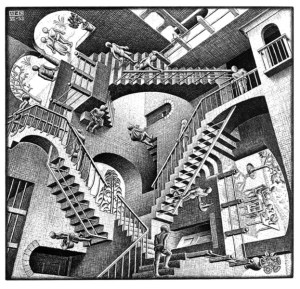 another. Monzó controls his readers’ perspectives like a camera man, panning from one character to another, zooming in & out. Each character makes an observation about the next, until he cycles through them all and returns to the first.
Centripetal Force, the only story in Part 4, is the most Borges-like. It is the literary equivalent of an M.C. Escher drawing.
In Guadalajara’s final stories Monzó focuses on individuals: a test taker, a forgetful prophet & his son, citizens caught up in a war and a reader. They are all nameless, often genderless, perhaps even archetypal – the next logical step in the evolution of the characters whose stories we’ve already read. They exist and act in closed systems, traveling in continuous circuits. They differ in that they are shown (or discover) escapes – trap doors built into the narrative. In the last, called simply Books a “passionate reader” attempts to choose a book from the four that sit on his table. He dissects each option, weighs its merits and discusses how it came into his possession. He picks each one up in turn, reads a few pages, puts it back down and attempts to decide which one to read through. It’s an internal conversation any bibliophile will recognize. The choice that he makes (or, doesn’t make) is the perfect denouement to this intricately and exquisitely crafted collection of stories.
Publisher: Open Letter, New York. (2011)
ISBN: 978 1 9348 2419 1



 If you know me, then you probably know of my obsession with podcasts. The latest and greatest being the Three Percent Podcast, hosted by Chad Post from Open Letter Books and Tom Roberge from New Directions. I couldn’t give you a reason why I like listening to these guys – other than the great recommendations for translated lit and their knowledge of random (and frightening) facts: such as the Power Rangers have been around for at least 13 seasons (actually 19). Chad’s baseball enthusiasm cracks me up, Tom comes off as a bit of a misanthrope which I find even funnier. Together they’re just a great team. I encourage you to listen to them.


