Oh yeah, that other book Michael Pollan wrote…

Garden books and winter go together.  After the garden has been covered over,  – first by autumn leaves, then frost, and finally a dusting of snow – what’s left for a gardener to do until March but read?

Of course, by now someone has told you that you HAVE to pick up a copy of The Omnivore’s Dilemma (if you haven’t already).  But before The Omnivore’s Dilemma; before “Eat Food.  Not Too Much.  Mostly Plants.” was made into a bumper sticker; before he wrote the letter telling the Obama’s to plant veggies on the White House lawn;  before all that Michael Pollan wrote a book called Second Nature:  A Gardener’s Education.  And by any standard it was, and remains, a beautiful piece of writing.

With the harvest moon, which usually arrives towards the end of September, the garden steps over into that sweet, melancholy season when ripe abundance mingles with auguries of the end anyone can read.  Except, perhaps, some of the tropical annuals, which seem to bloom only more madly the closer the frost comes.  Mindless of winter’s approach and the protocols of dormancy, the dahlia and the marigold, the tomato and basil, make no provision for frost, which might be a month away, or a day.  The annuals in September practice none of the inward turning of the hardy perennials, which you can see slowing down, taking no chances, turning their attention from blossom and leaf to root and stashed starch.  But instead of battening down the hatches, saving something for another day, the annuals throw themselves at the thinning sun, open-armed and ingenuous.  On those early autumn days when frost hangs in the air like a sword of Damocles, evident as sunlight to the lowest creature, is there anything more poignant than a dahlia’s blithe, foolhardy bloom?

Divided into four parts, conveniently corresponding to the four seasons, Second Nature was chosen by the American Horticultural Society as one of the seventy-five greatest gardening books written.  It was the book that put Michael Pollan’s blip on the radar.

Pollan’s attraction, in part, is his laid back take on the environment.  Consider: Eat Food.  Not Too Much. Mostly Plants. Not exactly the rallying cry of St. Crispin’s Day, is it?  Pollan has always struck me as the X-Generation’s environmentalist:  Eating his sushi at Nobu. Planting a tree only to find out after the fact he’s put in an invasive species.  Refusing to bow down at the altar of composting (an act he admits borders on heresy in some circles).  Or, my personal favorite, smirking at the pretensions of Thoreau playing at hermit in the forest.  Pollan makes environmentalism accessible to the masses.

Second Nature is the rare gardening/environmental book in that it is concerned with the real work of gardening. What many see as mundane tasks – mowing the lawn, weeding, composting and planting  – these gain greater social and political significance in Pollan’s hands.  He shows them to be more than simple acts which result in pretty landscapes or homegrown tomatoes in summer.  Second Nature calls upon readers to form a backyard environmental movement.

At the same time it provides a visceral scrapbook of what happens inside of a garden, embracing the Sisyphean cycle of planting, growing, harvest and death that is repeated yearly in backyards across the country.  Pollan’s genius is that he views the garden as both a micro- and  macrocosm.  Like Voltaire, he urges us to tend to our own garden. But he also applies this same philosophy to our greater environmental concerns.   He points out that, having taken the step to cultivate the earth, we have taken on the responsibility of managing it.   We  have insinuated ourselves into nature, irrevocably altering the “natural” course, which means we cannot step out and expect an anthropomorphized version of “Nature” to step back in as if there had been no interruption.  We cannot make the mistake of romanticizing nature, the virgin forest or the primeval landscape.  We must learn to work with what we have… what in many ways we have wrought.  Ultimately, the habits which make a good gardener, he believes, will make good environmentalists.

The gardener doesn’t take it for granted that man’s impact on nature will always be negative.  Perhaps he’s observed how his own garden has made this path of land a better place, even by nature’s own standards.  His gardening has greatly increased the diversity and abundance of life in this place.  Besides the many exotic species of plants he’s introduced, the mammal, rodent, and insect populations have burgeoned, and his soil supports a much  richer community of microbes than it did before….

The gardener doesn’t feel that by virtue of the fact that he changes nature he is somehow outside of it.  He looks around and sees the human hopes and desires are by now part and parcel of the landscape.  The “environment” is not, and has never been, a neutral, fixed backdrop; it is in fact alive, changing all the time in response to innumerable contingencies, one of these being the presence within it of the gardener.  And that presence is neither inherently good now bad.

By constantly shifting his perspective from the forest to the trees and back again, Pollan provides a larger action plan which can be implemented at a truly grass-roots level.  The genius is that he does so without ever stepping outside of his own garden.  In Second Nature he is not an environmental prophet, but another pilgrim on the journey. Sometimes misstepping, yet still doggedly making his way.  Trowel in hand.

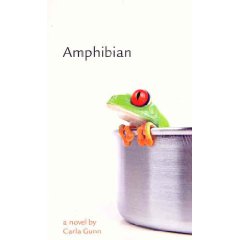
Amphibian by Carla Gunn

Amphibian by Carla Gunn

Phineas William Walsh is on a mission.  He’s going to save the world one endangered species at a time – and he’s depending on the Green Channel to help him do it.  That is until things go terribly, horribly wrong… as they only can in the life of a fourth grader.

Carla Gunn’s first novel, Amphibian, is both entertaining and engaging.  Written in the first person, it’s greatest strength may be it’s  narrator -  who owes a significant debt to Holden Caulfield (the hero and narrator of Catcher in the Rye).  And I mean that in the best possible way.  Because there’s more going on in Phin’s life than meets the eye – and he has a lot on his mind other than the planet.   His grandfather just passed away and his grandmother is sad.  His parents are separated and his Mom is dating a guy Phin doesn’t like. Not that he likes the idea of her dating. Period.  His father is out of the country 80% of the time and doesn’t know what’s going on.  He’s also the class bully’s favorite target.

And then (if that wasn’t enough!) there is the issue of the Gorachs from the planet Reull.  They’re destroying the planet and the other creatures of Reull need to figure out what to do before it is too late:

When my mom went to do some work in her study, I went upstairs and wrote about Reull and drew some pictures of them.  I drew the Jingleworm, who is red and white and has a part on the end of its body that jingles like a bell wherever it goes.  The Jingleworm’s predator is the Three-clawed Wren and it jingles so much that the Wren doesn’t have any problem finding it to eat.

But then the Jingleworms started to hide in the coat of the Green-tailed Squirrel, which didn’t mind because the loud jingling noise of the Jingleworm scared away its predator, the Electric Cat.  The Electric Cat’s ears are very sensitive to the jingling noise.  To it the Jingleworm sounds like somebody scraping their nails on a chalkboard sounds to us.  Sot the Jingleworm and the Green-tailed Squirrel have a symbiotic relationship.

The problem again is the Gorachs.  They are starting to collect Jingleworm tails for jingly bracelets, which they give to their Gorach children.  The Gorachs are parasites, so many of the animals are working on making more symbiotic relationships.  The Gorachs are in for a surprise.

Sure, it has become a cliché to compare novels narrated by juveniles to Catcher in the Rye, but in the case of Amphibian it works.  I’ve always believed that readers tend to miss the whole point of what Salinger was trying to do, – not surprising since his novel has mainly been defined by controversy.  The focus has always been on Salinger’s creation of a smart ass kid doing scandalous things, at least by 1950’s standards.  (You can just imagine what the reaction would have been to Gossip Girl)!

Subsequently, the story Salinger was trying  to tell is too often overlooked.  It is about a young boy, whose even younger brother has just died of leukemia.  Catcher in the Rye, at its heart, is about Holden attempting to deal with his grief.  And doing so in the absence of (I’d even go so far as to say his abandonment by) the adults who should be comforting him.  All the rest, the celebrated language and famous scene with the prostitute, is just so much white noise put up by Holden between himself and his emotions.

I do not want to misrepresent Amphibian as being a heavy novel, though it does touch on some surprisingly heavy material.  Phin is dealing with kinds of grief (and accompanying feelings of helplessness) that he’s too young to put a name to.  Or, like Holden, to even recognize.  But to Gunn’s credit, she chose to tell her story through the eyes of a 9-year old boy – which gives it a very different flavor than if it had been told by, let’s say, that boy’s mother or teacher.  Gunn reveals what’s going on with Phin in a way that perfectly captures a young child’s lack of perspective.   Divorce, bully, species extinction and permission to watch the Green Channel all carry equal weight and importance in Phin’s world.  Because everything is the end of the world – nothing is.  And Phin is a really funny kid.  His humor moves the book along quickly and, thankfully, saves it from becoming the angst-fest it might have been.

This morning I woke up to an awful sound – it was like a wolf trying to howl after swallowing one of those birthday-party noisemakers.  And it was standing over me.

I was a little worried about what I might see – maybe a pack of wolves having a birthday party and the cake just happened to be me – but I took a chance and opened my eyes.  My mother was standing there and that awful noise was coming from her.  She was smiling so I figured she wasn’t choking or something, so I asked her what the heck she was doing.

“I’m yodeling, Phin,” she said.

“But you’re not on a mountain,” I said.  “You’re standing over me making that awful sound.  I thought you were a wolf with something caught in its throat.  If you were a wolf, you’d have to be the alpha because if you were a submissive, the others would attack you for making a sound like that.”

Overall, Amphibian tells a good story about an average child working his way through a world where very little is under his control.  Carla Gunn allows us to smile at his tribulations knowing, even if he doesn’t, that Phin is one of the lucky ones.  Unlike Holden he has grown-ups around who love him and have his best interests at heart.  In the end, that makes all the difference.

Note:  Amphibian is Carla Gunn’s first novel.  While I’ve no knowledge of it being marketed as a YA, it is definitely  straddling the line between categories.  It does not rank high on the BookSexy scale, but it shouldn’t be dismissed.  Think of it as enviro-lit made more palatable by added sugar.

The book, itself, is more attractive than your average paperback  – with bright glossy covers.  The front end paper is a full page bleed b&w photo of a South America Red-eyed frog (the same little guy who made the cover).  The pages are nice and thick with a slightly corrugated texture.  The publisher is Coach House Books, out of Canada.