
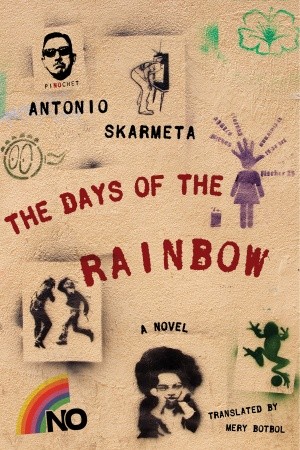
The art on the cover had me expecting to read about a more grass-roots, Banksy-esque graffiti driven campaign. This is not the case. Still, it’s a great cover.
In 1988 Chilean President and General Augusto Pinochet, after a 14-year dictatorship that began with the 1974 military coup which deposed then President Salvador Allende and in an attempt to legitimize his regime in the eyes of Western governments, called for a plebiscite. Citizens of Chile would vote – Yes or No – to Pinochet. “Yes” for Pinochet to remain in power and “No” for free elections. Overcoming the public’s fear of instability, unifying the disparate political parties of the left and withstanding government intimidation the “No” campaign miraculously won. The Days of the Rainbow is Antonio Skármeta’s fictional account of the making of that historic No! campaign. The film NO by Chilean director Pablo Larraín is an adaptation of Skármeta’s unpublished play El Plebiscito, on the same subject.
These are works of historical fiction. The book and film not only stray from the historical record – they differ significantly from each other. The Days of the Rainbow (the novel) features two protagonists. The first, Adrían Bettini, is a well-respected but unemployed ad executive who has been blacklisted by the Pinochet government. He is middle-aged, happily married with an 18-year old daughter. At the beginning of the book Bettini is approached by representatives from both the Yes! and No! and asked to head their respective campaigns. He, of course, chooses the No!
The second protagonist is Bettini’s daughter’s boyfriend, Nico Santos, who provides a first person narrative to his version of events. In the opening pages Nico’s father, a high school philosophy teacher, is arrested and disappears like thousands of others detained by the Pinochet government. These disappearances had become so commonplace that his father (who Nico refers to as Professor Santos as he is also his teacher) had discussed the possibility with Nico – dividing it into two possible scenarios.
… Professor Santos and I had foreseen this situation.
We had even given it a name: We called it the Baroque situation. If they took Daddy prisoner in front of witnesses, that meant they couldn’t make him vanish like they did to other people, people who are put in a bag with stones and are thrown into the ocean from a helicopter. There are thirty-five students in my class and we all saw with our own eyes that they took my father. He says that that’s an optimal situation, because they won’t kill him. In cases like this, he’s protected by the witnesses.
According to the Baroque plan, when they take Daddy prisoner I have to make two phone calls to two numbers I learned by heart, although I don’t know the names of the people who are going to answer. Then I have to keep living a normal life, going home, playing soccer, going to the movies with Patricia Bettini, going to school as usual, and at the end of the month, I have to go to the treasurer’s office to pick up his paycheck…
… If they had made my father disappear without any witnesses, we would be facing the Barbarian syllogism, and I would’ve probably died already of sadness.
After Professor Santos is taken Patricia and Nico are instrumental in helping Patricia’s father develop the No! campaign. They help Bettini to understand that he needs to incorporate joy, laughter and even silliness for the No! to succeed. The Days of the Rainbow is a completely engaging novel, easy to get lost in. The prose, translated by Mery Botbol, is light and simple as is the story. Young love, silliness, good overcoming evil, hope – all of these are present. Like Robert Ampuero’s The Neruda Case (which would pair nicely with The Days of the Rainbow) the goal here is as much to entertain as to educate.
NO (the film) has an entirely different cast of characters. The daughter and Santos family are absent. Bettini is replaced by the much younger and hipper René. René is a successful (and employed) advertising executive. He rides a skateboard, is a single father, and has an estranged wife who is repeatedly arrested for protesting against the Pinochet government. While there are references to disappearances, no one attached to the main characters is made to disappear. The film focuses on the marketing aspect of the No! campaign – the filming of the television spots and the attempts to intimidate the team behind them. Larraín chose to film it in a retro style which captures the washed out colors of 1970′s films. It is lovely and evocative. There’s very little background noise in the scenes, creating a sense of stillness that feels like being trapped in the eye of the storm. The overall tone is definitely much darker than The Days of the Rainbow and the stakes feel much higher with René constantly looking over his shoulder in fear. In one scene René’s boss, a man named Guzman who is a Pinochet supporter, meets with a government official in a plaza. The Minister asks him “Who are these people running the No! campaign? Who are these people I never heard of them?” “People to relaxed for my liking, minister.” “Be careful with what you say Guzman. If I open that door you have to close your eyes.”
The character of Guzman fills the same role as the random government official who initially approaches Bettini to work for the Yes! campaign in The Days of the Rainbow. He is both friend and enemy , and a far more complicated character than our heroes Bettini, Nico and René. Opportunistic is to crude a way to characterize Guzman’s and the official’s motivations. Pragmatic too kind.
The Atlantic has a wonderful interview of Genaro Arriagada, the true head of the No! campaign. Arriagada discusses the inaccuracies between the film and actual events. He does so without malice or censure. As in everything in life, authors writing historical fiction must pick their battles. The facts (for example – neither book or film mention that American consultants were involved in running focus groups that resulted in the campaign slogan “Joy is coming”) are subjugated and characters merged and simplified to illustrate larger ideas the author wishes to express. We, as readers, must accept that for Skármeta the individuals involved are not so important as what the movement meant to Chile. And that different mediums require different formulas. It’s not surprising that the book, the film and the facts do not entirely line up. I’d argue that the similarities rather than the differences in the two interpretations Skármeta has given us serve to highlight what truly matters: the plebiscite as a historic event; that hope for a future without Pinochet was marketed to the Chilean public as a product (like a brand of soda or a microwave); and most importantly, that when the Chilean plebiscite was over those who voted Yes! and those who voted No! went back to their joint lives without incident. The results stood. There were no riots or (as far as I my research went) retaliations. Those who were in power adapted and adopted the platforms necessary to remain in positions of power regardless of regime change. Everyone else went back to their daily lives.
Democracy in action. A government changes without too much disruption to anyone’s day-to-day life. Even the politicians’. In 1989 Patricio Aylwin, who had opposed President Allende once upon a time, won the election and became Chile’s new president. In 1990 Pinochet stepped down but remained Commander-In-Chief of the Army for eight more years. Despite the overall upbeat tone of the book and the “thriller” character of film, Skármeta isn’t afraid to show some cynicism. And why not? We are talking about politics.
Publisher: Other Press, New York (2013)
ISBN: 978 159051627 0


 My Reason: There’s been a ton of buzz around this novel.
 The Reason: History about books, where can you go wrong? Plus, I always like to attend at least one “industry” panel.
 The Reason: This was a coin flip – between The Corpse Washer and Jean-Marie Blas de Roblès’s Where the Tigers Are At Home (Roblès sits on a 4PM panel called Lost and Found: The Journey Begins At Home). I’ve been reading a lot of French novels lately and decided on something different.

