
Fantomas Versus the Multinational Vampires: An Attainable Utopia by Julio Cortázar (translated by David Kurnick)
April 25, 2015 § 1 Comment
Title: Fantomas versus the Multinational Vampires: An Attainable Utopia
Author: Julio Cortázar
Translator: David Kurnick
Publisher: Semiotext(e), Los Angeles (2014)
ISBN: 978 1 58435 134 4
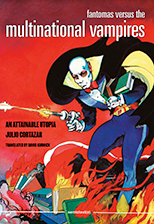 One problem with coming to a book without any useful prior knowledge is that your risk being blindsided. For example: sometimes you pick up a novella (Say by Julio Cortázar, an author with whom you’ve had enjoyable experiences in the past. An author who writes playful, Escher-esque short stories and is known for the novel Hopscotch, in which the chapters can be read straight through or mixed up in an entirely non-linear way) seduced by the way the author has used visual images as part of the narrative rather than in the supportive role of illustration only to suddenly, inexplicably, find yourself reading a political tract on the evils of global capitalism. Surprise!
Cortázar is a genius. Fantomas was a comic book hero from the 1970’s written by Gonzalo Martré and drawn by Víctor Cruz Mota. All the comic book pages featured (and commented on by the narrator) are from the actual issue entitled Fantomas, la amenaza elegante: La inteligencia en llamas (Fantomas: The Elegant Menace and The Mind on Fire). The premise behind Cortázar’s book is that the narrator, Cortázar, finds himself reading the Fantomas comic book while on a train ride home after attending the Second Russell Tribunal in Brussels – (we’ll get back to the Tribunal later). As he reads he discovers that he, Alberto Moravia, Octavio Paz & Susan Sontag are all characters in the comic book. The lines between the comic book story and the “real world” of the novella begin to blend and merge until the readers finds themselves immersed in a marriage of the two. Books around the world are disappearing. Libraries are being burned. Intellectuals are being alerted and expressing suitable horror. Our hero Fantomas leaps into action (and through several windows) in order to stop the villain responsible.
But as the story progresses the intellectuals, with Cortázar and Susan Sontag at the helm, begin to question their priorities. What is the value books when compared to people? And as Sontag tells Julio, “Fantomas realizes now that he’s been tricked, and it’s not a nice thing for him to realize… Now he and many more are realizing that the destruction of the libraries was just a prologue. It’s too bad I’m no good at drawing – if I were I’d hurry up and prepare the second part of the story, the real story. It’ll be less attractive to readers without the pictures” we all know she’s not just talking about Fantomas. Cortázar, at least, had a sense of humor. Because if Susan were truly being forthright she would have explained that the destruction of libraries was actually a distraction, rather than a prologue. More appropriately: a lure. Which brings us to the Second Russell Tribunal.
 Most of the following information can helpfully be found in the Appendix of Multinational Vampires. In January, 1975, the Second Russel Tribunal was held. The First Russel Tribunal (perhaps better known as the International War Crimes Tribunal) originally took place in 1966 and was organized by Bertrand Russel & Jean Paul Sartre to investigate crimes against humanity committed in Vietnam by the United States of America.* To date there have been five Russel Tribunals held with the most recent taking place in 2012 on Palestine. The second, with which we’ll concern ourselves because it is the one on which Multinational Vampires is predicated, dealt with Latin America – instigated by Pinochet’s coup d’etat in Chile. Ultimately, the tribunal did not limit itself to Chile. Latin America was the CIA’s playground at the time and many of those attending the Tribunal had Communist leanings, so there was plenty of material for the delegates to work with. The problem was and remains that the Tribunals are only symbolic. Those involved had no power in the making of policy. Their goal and hope was that through their participation the atrocities, injustices and economic manipulation would be exposed and brought to the public’s attention.
Which is why Cortázar wrote Fantomas Versus the Multinational Vampires who, if you haven’t figured it out by now, are the international corporations. The novella is an interesting bit of Cold-War ephemera on the one hand and a neat bit of literary slight-of-hand on the other. My only problem with it is the transition from experimental writing to political pamphlet was so unexpected that the second half of the book became something of a blur as I tried to figure out what had just happened. Rather like jumping on a subway train expecting to wind up in Park Slope and finding yourself on a platform in Jackson Heights, Queens. What saves Multinational Vampires, and make it readable, is Julio Cortázar’s dry sense of humor, his clever structure and the way he has his narrator move in and out of the frames of the comic book. And, not least of all, the realization that there is still some value in Cortázar’s message. Because unfortunately, at least in the case of multinational vampires, the world hasn’t changed as much as we’d like to believe.
Fantomas Versus the Multinational Vampires has been longlisted for the 2015 Best Translated Book Award. It’s a wonderful translation – the dialogue that propels most of the novella is delivered rapid fire and the transitions I mentioned earlier – between the “main” story, the comic book and the politics – probably weren’t the easiest to execute. Despite all that, and the fact I enjoyed it quite a bit, I’d be very surprised if it made it onto the shortlist.
*Cortázar attended the First Russell Tribunal, as well.
His Own Man by Edgard Telles Ribeiro, translated from the Portuguese by Kim M. Hastings
September 15, 2014 § Leave a comment
Title: His Own Man
Author: Edgard Telles Ribeiro
Translator: Kim M. Hastings
Publisher: Other Press, New York (2014)
ISBN: 978 159051 698 0
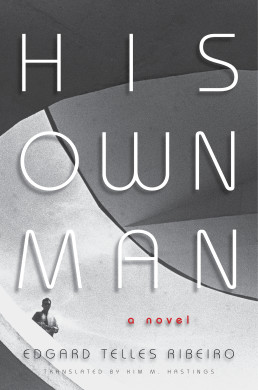 Marcilio Andrade Xaviar – known as Max to friends & colleagues alike – is handsome, charismatic, intelligent, cultured and endlessly complicated. In short, the perfect diplomat. It is the late 1960’s and he is embarking on what will be a remarkable career in the Brazilian Foreign Service. A career that will span some of the most tumultuous decades in Latin American history. Through the coups and purges, the government shifts from left to right and back again, the making & breaking of political alliances – Max thrives. He is a golden boy. Incapable of a misstep, even if he tried.
Across Latin America governments will fall (in the words of one character) like “right-wing dominoes”. Socialist and Communist leaders will be replaced by military dictators backed by Western powers. A Cold War game of RISK played on Central & South American maps. “… We went through Brazil in sixty-four and from there all the countries toppled one after the other, just like a house of cards: Argentina in sixty-six; Uruguay and Chile in seventy-three (a good year for us); Peru at some point, I no longer remember when; then Argentina again in 1976 (after the brief and pitiful Peron hiatus); and so on. A beautiful domino effect… just perfect.”
And at the center of it all stands Max. Except we aren’t given Max’s version of events. Instead, His Own Man is narrated by a colleague and former friend. Obsessed with the trajectory of Max’s career and the wrecked lives left in its wake, the narrator (known only as N.) seeks out Max’s ex-wife, associates, even Max himself – anyone and anything that can provide insight into the actions of his former friend. Structured like Faulkner’s Absalom, Absalom, Bolano’s Distant Star and Matthiesson’s Shadow Country trilogy – His Own Man pieces together a flawed portrait from bits of rumor, chance encounters, speculation and fading memories. And like the main characters of those books, Marcilio Andrade Xaviar comes to embody the evils of the society ruled by terror. Operation Condor, the Argentine Dirty Wars, the kidnapping of the Uruguayans, Pinochet’s coup and Chilean “Operation Silence”, the torture & murder of millions – somehow we are meant to understand that Max had a hand in all of it. Yet, when pressed, he appears entirely disinterested in politics.
“After giving me a good-natured glance, Max repeated, ‘That’s right, he drank from the wrong well.’ And he concluded, ‘He only saw what was directly in front of him. Whereas…’”
I finished describing the scene to Marina. Turning his back on the ministry esplanade, Max had slowly rotated, a motion I had to follow, given how close to him I was standing. And he’d gestured broadly with is arm from right to left through the space in front of us. His fingers glided past Burle Marx’s suspended gardens, descended to the people on the marble terrace – lost in their hopes and longings – and, without lingering, moved over the circle formed by the president and his entourage, all lively and elated. With the elegance of an orchestra conductor, his hand then swept past various groups of men in tailored suits,hovered over well-coiffed made-up women, reaching the new graduates and their relatives, until finally landing on the works of art, which ranged from Aleijadinho to Portinari, from colonial furniture to Persian rugs. Once his panorama was complete, he leaned toward me and whispered, “… Whereas this is what I pursued.”
Ribeiro uses N.’s idealism to contrast Max’s opportunism, and then leaves it to his readers to determine the grey area where the truth resides. Max is mercenary, ruthless and ambitious. But N.’s idealism never translates into concrete action. N’s position allows him to shelter his family from the violence and upheaval taking place around them – but he fails to use it to change or even impact the world. He coasts through events as a witness more than a participant. In fact, a lot of coasting seems to occur throughout the plot of His Own Man. Max seldom instigates events, rather he stumbles into most of the opportunities that shape his career. Or finds himself manipulated into position by foreign government agencies. His Own Man is something of a misnomer.
It stands to reason that a former diplomat turned author would avoid the clichés found in most espionage novels. Edgard Telles Ribeiro – journalist, film critic, author, career diplomat with 47 years in the Brazilian Foreign Service and the UN – knows the world of which he writes intimately. Not the shadow world of 007 and George Smiley, the real Diplomatic Corps is made up of men and women who exist somehow independent of the governments and nations they serve. Stationed in embassies located around the globe, they often seem far removed from the events taking place in their home countries even as they help shape them. They live their lives, marry and raise their children in little oasis set on foreign soil. Ribeiro’s characters are intelligent and cultured, they are surrounded by elegance and view world politics as a particularly challenging game of chess. They believe themselves grandmasters, moving the pieces across the board. But in reality they are just as likely to be pawns – manipulated and eventually sacrificed.
Kim M. Hastings translation is straightforward, with some lovely moments like the passage quoted above. Overall, though, I found His Own Man more interesting than engaging. The Latin American history is fascinating and the premise – an espionage/political commentary novel set firmly in the diplomatic (versus the intelligence) community – is a novelty. But the 1st person narrator, so important to this novel’s success, comes across as a less charming, a less engaging, a less vibrant version of Max. That N., in his 60’s at the time of the story’s telling, is jaded and consumed by regret lends authenticity to his character. But it also flattens out his perception of people and events. The sections involving Max’s wife Marina are some of the best in the book, because N.’s empathy and humanity is on display. I’d have liked to seen more of that same kind of emotional depth somewhere in N.’s portrayal of Max.
The Days of the Rainbow by Antonio Skármeta & the film NO
September 15, 2013 § 2 Comments
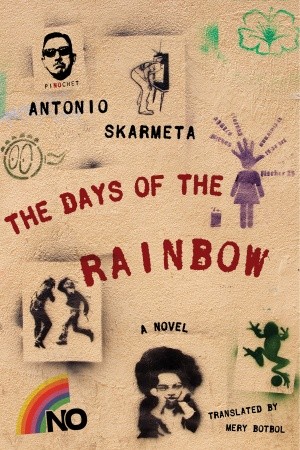
The art on the cover had me expecting to read about a more grass-roots, Banksy-esque graffiti driven campaign. This is not the case. Still, it’s a great cover.
In 1988 Chilean President and General Augusto Pinochet, after a 14-year dictatorship that began with the 1974 military coup which deposed then President Salvador Allende and in an attempt to legitimize his regime in the eyes of Western governments, called for a plebiscite. Citizens of Chile would vote – Yes or No – to Pinochet. “Yes” for Pinochet to remain in power and “No” for free elections. Overcoming the public’s fear of instability, unifying the disparate political parties of the left and withstanding government intimidation the “No” campaign miraculously won. The Days of the Rainbow is Antonio Skármeta’s fictional account of the making of that historic No! campaign. The film NO by Chilean director Pablo Larraín is an adaptation of Skármeta’s unpublished play El Plebiscito, on the same subject.
These are works of historical fiction. The book and film not only stray from the historical record – they differ significantly from each other. The Days of the Rainbow (the novel) features two protagonists. The first, Adrían Bettini, is a well-respected but unemployed ad executive who has been blacklisted by the Pinochet government. He is middle-aged, happily married with an 18-year old daughter. At the beginning of the book Bettini is approached by representatives from both the Yes! and No! and asked to head their respective campaigns. He, of course, chooses the No!
The second protagonist is Bettini’s daughter’s boyfriend, Nico Santos, who provides a first person narrative to his version of events. In the opening pages Nico’s father, a high school philosophy teacher, is arrested and disappears like thousands of others detained by the Pinochet government. These disappearances had become so commonplace that his father (who Nico refers to as Professor Santos as he is also his teacher) had discussed the possibility with Nico – dividing it into two possible scenarios.
… Professor Santos and I had foreseen this situation.
We had even given it a name: We called it the Baroque situation. If they took Daddy prisoner in front of witnesses, that meant they couldn’t make him vanish like they did to other people, people who are put in a bag with stones and are thrown into the ocean from a helicopter. There are thirty-five students in my class and we all saw with our own eyes that they took my father. He says that that’s an optimal situation, because they won’t kill him. In cases like this, he’s protected by the witnesses.
According to the Baroque plan, when they take Daddy prisoner I have to make two phone calls to two numbers I learned by heart, although I don’t know the names of the people who are going to answer. Then I have to keep living a normal life, going home, playing soccer, going to the movies with Patricia Bettini, going to school as usual, and at the end of the month, I have to go to the treasurer’s office to pick up his paycheck…
… If they had made my father disappear without any witnesses, we would be facing the Barbarian syllogism, and I would’ve probably died already of sadness.
After Professor Santos is taken Patricia and Nico are instrumental in helping Patricia’s father develop the No! campaign. They help Bettini to understand that he needs to incorporate joy, laughter and even silliness for the No! to succeed. The Days of the Rainbow is a completely engaging novel, easy to get lost in. The prose, translated by Mery Botbol, is light and simple as is the story. Young love, silliness, good overcoming evil, hope – all of these are present. Like Robert Ampuero’s The Neruda Case (which would pair nicely with The Days of the Rainbow) the goal here is as much to entertain as to educate.
NO (the film) has an entirely different cast of characters. The daughter and Santos family are absent. Bettini is replaced by the much younger and hipper René. René is a successful (and employed) advertising executive. He rides a skateboard, is a single father, and has an estranged wife who is repeatedly arrested for protesting against the Pinochet government. While there are references to disappearances, no one attached to the main characters is made to disappear. The film focuses on the marketing aspect of the No! campaign – the filming of the television spots and the attempts to intimidate the team behind them. Larraín chose to film it in a retro style which captures the washed out colors of 1970’s films. It is lovely and evocative. There’s very little background noise in the scenes, creating a sense of stillness that feels like being trapped in the eye of the storm. The overall tone is definitely much darker than The Days of the Rainbow and the stakes feel much higher with René constantly looking over his shoulder in fear. In one scene René’s boss, a man named Guzman who is a Pinochet supporter, meets with a government official in a plaza. The Minister asks him “Who are these people running the No! campaign? Who are these people I never heard of them?” “People to relaxed for my liking, minister.” “Be careful with what you say Guzman. If I open that door you have to close your eyes.”
The character of Guzman fills the same role as the random government official who initially approaches Bettini to work for the Yes! campaign in The Days of the Rainbow. He is both friend and enemy , and a far more complicated character than our heroes Bettini, Nico and René. Opportunistic is to crude a way to characterize Guzman’s and the official’s motivations. Pragmatic too kind.
The Atlantic has a wonderful interview of Genaro Arriagada, the true head of the No! campaign. Arriagada discusses the inaccuracies between the film and actual events. He does so without malice or censure. As in everything in life, authors writing historical fiction must pick their battles. The facts (for example – neither book or film mention that American consultants were involved in running focus groups that resulted in the campaign slogan “Joy is coming”) are subjugated and characters merged and simplified to illustrate larger ideas the author wishes to express. We, as readers, must accept that for Skármeta the individuals involved are not so important as what the movement meant to Chile. And that different mediums require different formulas. It’s not surprising that the book, the film and the facts do not entirely line up. I’d argue that the similarities rather than the differences in the two interpretations Skármeta has given us serve to highlight what truly matters: the plebiscite as a historic event; that hope for a future without Pinochet was marketed to the Chilean public as a product (like a brand of soda or a microwave); and most importantly, that when the Chilean plebiscite was over those who voted Yes! and those who voted No! went back to their joint lives without incident. The results stood. There were no riots or (as far as I my research went) retaliations. Those who were in power adapted and adopted the platforms necessary to remain in positions of power regardless of regime change. Everyone else went back to their daily lives.
Democracy in action. A government changes without too much disruption to anyone’s day-to-day life. Even the politicians’. In 1989 Patricio Aylwin, who had opposed President Allende once upon a time, won the election and became Chile’s new president. In 1990 Pinochet stepped down but remained Commander-In-Chief of the Army for eight more years. Despite the overall upbeat tone of the book and the “thriller” character of film, Skármeta isn’t afraid to show some cynicism. And why not? We are talking about politics.
Publisher: Other Press, New York (2013)
ISBN: 978 159051627 0


The Polish Boxer by Eduardo Halfon (translated from the Spanish by Daniel Hahn, Ollie Brock, Lisa Dillman, Thomas Bunstead & Anne McLean)
October 9, 2012 § 3 Comments
 Eduardo Halfon is an exciting new Guatemalan author. Chosen as one of the best young Latin American writers at the Hay Festival of Bogotá in 2009, he’s also received a José María de Pereda Prize for the Short Novel and a Guggenheim Fellowship in 2011. He’s published 9 novels, The Polish Boxer is the first to be translated into English.
I believe The Polish Boxer is as much a novel as Jennifer Egan’s A Visit from the Goon Squad. Which is my complicated way of saying it is a book of short stories. One clue is the way Halfon repeats the same bits of information in multiple stories. As if he wasn’t expecting them to be collected in one place when he wrote them. The narrator, – a professor, author and traveler named Eduardo Halfon – is the unifying factor. Sound familiar? And yes, you can argue that because the themes and characters carry through multiple stories (or, if you prefer, chapters) The Polish Boxer is a novel. But each of these chapters is a self-contained unit.
Why am I so fixated on whether this is a collection of short stories versus a novel? Maybe because writing a short story collection is difficult and I want to give credit where credit is due. Or maybe it’s because any one of the stories in The Polish Boxer is easily as good as what’s been published in the fiction section of The New Yorker.
The title story is about Halfon’s grandfather. A Polish concentration camp survivor who tells his young grandson that the numbers tattooed on his forearm are a phone number. Halfon explains, “In the 1970’s, telephone numbers in Guatemala were five digits long.” The truth was his grandfather received the numbers at Auschwitz and it was a Polish boxer who saved his life. The truth, though, is a complicated thing. And Halfon discovers that the true story may have been simpler and more complicated than the one his grandfather told him.
These stories are populated by men and women intent on pulling something more from life. My favorites feature Milan, a troubled Serbian classical pianist with gypsy blood. Halfon and his girlfriend Lía meet Milan at a music festival in Antigua. They become friends – Milan affectionately calls Halfon “Eduardito”. In the months that follow he sends Eduardito cryptic postcards from all over the world in an attempt to share his own, personal, story.
I got a postcard of the Golden Gate Bridge, sent from San Francisco. Milan wrote: Last night, as I was playing in a beautiful auditorium, everything began to tremble. Some people stood. Others left. And I kept playing Stravinsky as if nothing much were happening. Nothing much was happening. In Romany, Eduardito, earthquake is I phuv kheldias, which means the earth danced.
These are beautiful stories, but we’ve all read beautiful stories before. What dazzles me about Halfon is his ability to capture people – men and women – in flux. The action continues even after the narrative ends. Often the last sentence comes too suddenly, characters are cut off mid-motion, mid-thought. Things are left unexplained, unfinished, inferring that there are still stories to tell – forever expanding out like the root system of a tree. It makes me wonder. What’s in those other 8 books?
Among the postcards Milan sends Eduardito is one about Black Ellen: a gypsy storyteller. She would shout out to the crowd and if they didn’t shout back the answer she wanted she would leave. Shake her skirts out and go, story unfinished. “Sounds like Scheherazade, said Lía, in bra and panties, painting her toenails cherry red.” And she’s right. About Black Ellen and about Eduardo Halfon.
Hopefully now they’ve finally begun appearing in English, Halfon’s stories will continue to do so… with only minimal interruptions.
Publisher: Bellevue Literary Press, New York (2012)
ISBN: 978 1 934137 53 6


“I could live under a table reading Borges.” – Roberto Bolaño
May 4, 2012 § 2 Comments

The covers of the Pearls are minimalist & gorgeous. The orange color block is embossed, as is all the text. And, like every other New Directions book I’ve seen, it’s numbered. Imagine a complete set lined up on a bookshelf… stunning!
Everything and Nothing is a collection of Jorge Luis Borges’ writings, released in a New Directions Pearl edition. I’m a huge fan of the Pearls – they’re throwbacks to a time when paperbacks came in 4-1/2″ x 7″ format and fit handily inside your jacket pocket. Ficciones holds a special place in my heart. But this particular collection is beautiful, compact and contains some of the author’s best work. If you already know & love Borges, it is the perfect vehicle to become reacquainted. If you’ve yet to have the pleasure of reading Borges’ sublime (truly!) prose, Everything and Nothing is a powerful introduction to the best of the short stories, lectures and essays.
Borges is one of the few writers I’ll read over and over again. His prose style is clean, succinct. It nicely balances out against the complexity and cerebral quality of his subject matter. The Lottery in Babylon is a story about a society ruled entirely by chance. At first it seems ridiculous, – a city in which all decisions are made through lottery. But as the story progresses, the plot inverts and life in Babylon becomes eerily familiar. The Garden of Forking Paths is spy vs. spy, a labyrinthine espionage tale with a twist at the end you’ll never see coming. Tlön, Uqbar, Orbis Tertius is supposedly about the internet… but I, personally, don’t see it. For me it’s a much more straightforward narrative on the manipulation of reality and history by a small group of individuals. My absolute favorite of the collection, Blindness, is a lecture Borges gave in the 1970’s. If I am ever stranded on a desert island I want it with me.
For me to live without hate is easy, for I have never felt hate. To live without love I think is impossible, happily impossible for each one of us. But the first part – “I want to live with myself, / I want to enjoy the good that I owe to heaven” – if we accept that in the good of heaven there can also be darkness, then who lives more with themselves? Who can explore themselves more? Who can know more of themselves? According to the Socratic phrase, who can know himself more than the blind man?
A writer lives. The task of being a poet is not completed at a fixed schedule. No one is a poet from eight to twelve and from two to six. Whoever is a poet is one always, and continually assaulted by poetry. I suppose a painter feels that colors and shapes are besieging him. Or a musician feels that the strange world of sounds – the strangest world of art – is always seeking him out, that there are melodies and dissonances looking for him. For the task of an artist, blindness is not a total misfortune. It may be an instrument.
Four separate translators worked on the stories and essays that make up Everything and Nothing. Donald A. Yates, who also wrote the introduction; James E. Irby; John M. Fein and Eliot Weinberger. This is worth mentioning because Borges voice remains consistent from piece to piece, regardless of who is translating.
I don’t speak or read Spanish. But in the past I’ve read multiple works of a single author, each interpreted by a different translators. The substitution of one translator for another can be glaringly obvious. After reading a book translated by Lucia Graves I went looking for more novels by its Spanish author. The next book I picked up was (unfortunately) done by a different translator in whose hands the characters became flat and two-dimensional. I never bothered with that author again. To the point: With great power comes great responsibility. The credit for the smooth flow of this collection is a testament to the skill of the translators. And while I know it must be so, how could the original Spanish possibly be any better?
Please forgive the poor metaphor, but I find reading Borges’ soothing. Comparable to watching words float by on a stream. Every so often you fish out an idea like so much flotsam. Sometimes to keep, sometime to throw back. You can spend hours doing this. Days. Possibly weeks. And be perfectly content the entire time.
Now, if you’ll excuse me? It’s time to crawl back under my table.
Publisher: A New Directions Pearl, New York (2010)
ISBN: 978 0 8112 1883 2
