
Is Emotionally Damaged the New Sexy?

File:Skull and crossbones.svg

April Fools seems like it’d be the perfect day to publish this particular post.

Dear readers, forgive me. In fact, I urge you to stop reading now.  Skip this post altogether. I lost a bet. I lost a bet to Lori @TNBBC (feel free to blame her) and as forfeit I had to read 50 Shades of Grey. Worse still, I have to review it.

Let’s get this over with.

To say that 50 Shades of Grey is poorly written is the definition of “understatement”.  It’s horrible.  In terms of style, the writing is almost comically repetitive. Actually take out the almost.  It’s so terribly written that I refuse to even put up a sample.

Yet the prose (I can’t believe I referred to it as prose) is not the most egregious sin perpetrated here.  Because, let’s face it, few people are reading this for it’s literary value.  What is unforgivable is the complete lack of cohesion or logic.  There is no one element to this book that works.  And the only way I can explain that is to break it down in parts and discuss each one individually.

Don’t use big words (or concepts) you don’t understand.

E.L. James seems to have a fascination with, and limited understanding of, the subconscious, using it in the place of a conscience throughout the book. To be fair, what she’s really referring to is the Superego… but that would be raising the intellectual bar of this narrative higher than I believe Ms. James can reach. The same can be said regarding the heroine’s Inner Goddess – who makes FREQUENT appearances.  She turns out to be less the Jungian psychological archetype and more of a professional dancer. At various stages of the book she dances the cha-cha, the mambo and the rumba.

Originality

It’s painfully obvious that 50 Shades’ original incarnation was as Twilight fan fiction.  Now, to their credit, the author and her publisher have never denied this.  But they have made some dubious claims that the fan fiction was heavily edited prior to being released in novel form.  But anyone who has read Twilight, or seen the films, will be able to play Spot the Twilight Character Look-A-Like.  The first book has a Rosalee & an Emmit, an Alice & Esme.  Bella’s entire family – mother, stepfather and father – are kept essentially intact for Anastasia/Ana (50 Shades’ heroine).  BUT the prize goes to Ana’s male friend who – instead of being a Native American boy named Jacob – is a Latino boy named José Rodriquez.  (Just in case there is any doubt of his ethnicity, José helpfully employs the phrase “Dios Mio!” at the appropriate moments).

With so much of the source material plot remaining intact, vampirism obviously had to be taken out of the equation.  E.L. James realized she’d need an alternative alternative-lifestyle to avoid a lawsuit for blatant copyright infringement and to create narrative tension – so the hero, Christian Grey, is into BDSM instead of bloodsucking.

I won’t bore you with the many plot points the two books share.  Suffice it to say that at the end of 50 Shades the hero & heroine break-up, and the heroine is emotionally devastated and in the fetal position… does any of this sound familiar?

But it’s sexy… right?

Yet poor writing, borderline plagiarization… all of this pales in comparison to the sex. The amazingly uninspired, non-sexy sex. There is nothing erotic in what takes place between Ana and Christian.  James is not Anais Nin, or even a Marquis de Sade. Even if she were, it’s hard to get past the fact that Christian is probably the most damaged human being I’ve ever encountered in (I use the term loosely) literature. He is not depraved or bored or evil.  He is the son of a crack whore, with burn-marks scattered over his body. He was initiated into BDSM at the age of 16 by a friend of his adopted mother’s. He does not like to be touched during intimacy. He does not make love – he “f#$% hard”. (Which, by the way, summarizes just about every sex scene in the book). He repeatedly explains to  Ana that he doesn’t know how to be in normal relationship. He is, unsurprisingly, in therapy. And he uses the endearment “baby” way too much. Creepy and disturbing yet?

Don’t worry, it gets better. Ana starts out as a virgin (because James’ seems to have a thing for stereotypes) and spends the entirety of the book crying. In one scene she emails Christian that she is breaking it off as a joke (indicative of her maturity level) and he furiously storms over to her apartment and proceeds to sexually dominate her. He gives her a spanking.  She, of course, loves it. At the same time she feels degraded.  I believe at this juncture her subconscious performs the macarena, but don’t quote me on that. Like every encounter Ana has with Christian – this one ends in tears. She’s so confused! She loves him but (the implicit message is) society has turned her into a prude!

What I find fascinating about 50 Shades of Grey is that it has so many fans who seem to be completely missing the point: that his BDSM lifestyle is the least disturbing thing about Christian Grey. My problem with this book has nothing to do with the kink… two consenting adults have the right to do as they please. But no one seems to be talking about the severe dysfunction of this relationship. Kinky sex and severe emotional damage are two different things entirely. (Kathryn Casey, in Forbes, touches on this, though I’m not sure I completely agree with her specific concerns). The latter just isn’t sexy.

But who am I to judge? How can 65 million readers be wrong? Co-dependence, emotionally torturing the person you profess to love, continuing a relationship with the person who molested you as a child – that’s obviously the new sexy.

I never thought I’d miss the sparkly vampires…

Add to FacebookAdd to DiggAdd to Del.icio.usAdd to StumbleuponAdd to RedditAdd to BlinklistAdd to TwitterAdd to TechnoratiAdd to Yahoo BuzzAdd to Newsvine

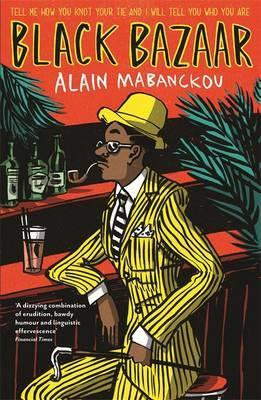
Black Bazaar by Alain Mabanckou, translated from the French by Sarah Ardizzone

Terroir in a novel, unless it’s a historical novel, isn’t always as important as we’d like to make it.  The plot seldom hinges on it.  What I mean is – for all the hype around Nordic Crime, change the place & character names in The Girl with the Dragon Tattoo and it could be set almost anywhere.  Bassman’s We Monks & Soldiers might be predicting various nations’ apocalyptic future.  And none of Yoko Ogawa’s short stories in Revenge scream Japan, even if her prose does.

But an Alain Mabanckou novel is different.  He writes very specifically about Africans, whether in their home country or abroad.  And if you were to change that there is no book.  Even when American literary influences sneak in he re-works it in the scope of his experiences.  In a 2007 interview on Bookslut, Mabanckou acknowledged his admiration for Brett Easton Ellis’ American Psycho.  He carefully points out that the protagonist of African Psycho couldn’t be more different from the urbane investment banker Patrick Bateman.  Each man is a product of his environment.  And the Little Congo is a long way from Manhattan.

But not from Paris.

Société des ambianceurs et des personnes élégantes, Les Sapeurs or Le Sap for short, originated in Congo-Brazzaville (aka Little or French Congo – not to be confused with the Big Congo of King Leopold’s Ghost) where Mabanckou is from and many of his stories are set.  It is a fashion movement for men that centers around expensive designer clothing – flamboyant suits with cascading pocket handkerchiefs, walking sticks, Eton-collared shirts and bow ties at one end of the spectrum; modern gear from Dolce & Gabana, Japanese designers whose names I don’t recognize and Dior at the other.  There’s been a boom in articles and photo books on these men in recent years, in which you’ll inevitably find the word “dandies”.  Because just as important as what Le Sap wears, is how he wears it.  It’s a club for high-style and personal elegance that, we’re told in the latest Mabanckou novel to be released in the States*, that the Congolese brought  to France. Not vice-versa.

 I make a point of wearing a suit because you’ve got to “keep up appearances”, as we say among the Society for Ambient People and Persons of Elegance, SAPPE, which, without wanting to be contentious, is an invention from back home, born in the Bacongo district of Brazzaville,towards the Total roundabout.  We’re the ones who exported “Sappe” to Paris, and don’t let anyone tell you otherwise, because lately there are so many false prophets swarming these streets in the City of Light, to the point where it’s getting difficult to separate the wheat from the chaff.

Black BazaarThe narrator of the 2009 novel Black Bazaar (the English edition was released in 2012 by Serpent’s Tail and has been longlisted for the IFFP) is both a member of Les Sapeurs and, like it, an import from Congo-Brazzaville.  He’s lived for over a decade in Paris.  He goes by the name “the Buttologist” amongst his friends at Le Jip’s Bar for reasons that shouldn’t need to be explained.

The Buttologist is alternately writing and inhabiting events.   His girlfriend, a French woman he calls “Original Colour”, has run off with a tom-tom player from a traditional music group.  She’s taken their baby daughter with her.  The Buttologist, left behind in the now empty studio apartment they once shared, buys a typewriter and sets about writing.  He writes about what he knows. Giving voice not only to his own story, but to his friends’ and neighbors’ – immigrants who’ve all come to France from former French colonies in Africa, the Middle East and the East Indies.  And (like a Tarantino film) almost every character in Black Bazaar gets a soliloquy in which to air their opinions – usually on the “colonial legacy”.  These orators are invariably eccentric, cocky and deeply convinced that their view is the correct one. They deliver their speeches from atop the soapbox in  pitch perfect dialogue.  So perfect that it’s easy to imagine you’re eavesdropping from a stool at Jip’s.  Mabanckou is not telling you about this world, he’s asking you to become a part of it.

I wondered why Haitians are either brilliant writers or taxi drivers for life in New York and Miami.  And when they’re writers they are in exile.  Do writers always have to live in another country, and preferably be forced to live there so that they’ve got things to write about and other people can analyse the influence of exile on their writing?…

…These Haitian writers are like hunted birds.  They’ve had more than thirty-two coups d’état back home and not a country in the world has equalled this record yet.  With each coup d’état, flocks of writers have emigrated.  They left everything behind, setting out with nothing apart from their manuscripts and their driving licence.  I wish I’d been born Haitian so I could be a writer in exile who understands the song of the migrating bird, but I don’t have any manuscripts, or a driving licence to become, in the worst-case scenario, a taxi driver in the streets of Paris …

Black Bazaar is filled with passages like this – delivered with haunting prose and a wry humor.  Everything is taken in stride.  The narrator and his friends are always adapting, without surrendering their sense of who they are.  As a character tells him at the end of the book, “Above all, you must never forget your own country, never…”

Alain Mabanckou and the Buttologist have a lot in common. Both were born in Congo-Brazzaville.  Both immigrated to Paris as a young men and spent a lot of time at Le Jip’s, a bar frequented by African expats on rue St. Denis.  (The author currently lives in America, a country where his writing is disgracefully under-appreciated).  And, like his narrator, Alain Mabanckou has written about what he knows.  Whether he’s describing the African diaspora, the lives of Congolese immigrants in France and their conflicting opinions on the legacy of colonialism.  Or explaining le Sappeurs or the music of Papa Wemba.  He does it with warmth, and more importantly with authority.  Alain Mabanckou is an author for who terroir is everything.

Publisher:  Serpent’s Tail, London (2012)
ISBN:  978 1 8476 5657 5

Add to FacebookAdd to DiggAdd to Del.icio.usAdd to StumbleuponAdd to RedditAdd to BlinklistAdd to TwitterAdd to TechnoratiAdd to Yahoo BuzzAdd to Newsvine

*only available digitally