
2015 Translation Awards – By the Numbers
April 13, 2015 § 7 Comments
None of the 10 authors nominated for the Man Booker International Prize has a book on the 4 longlists.
There are 76 spots on the combined longlists, including the 6 write-in spots for the Typographical Translation Prize. (3 of the 6 write-in titles show up on 1 of the 3 other longlists).
There are 62 unique titles across the 4 lists.
34 of the books are from Europe, 14 Latin America, 9 from Asia, 3 from Africa, 1 from the Middle East, 1 from North America.
France has the most books on the combined lists – 7.
There are 19 female authors represented & 41 male authors.
Bohumil Hrabal has 2 separate titles on The Best Translated Book Award longlist (translated by 2 different translators).
The I Ching translated by John Minford has no attributable author.
Baboon by Naja Marie Aidt, translated by Denise Newman, is the only title on 3 lists – The Best Translated Book Award, The PEN Translation Prize & The Typographical Translation Prize. All 3 are American prizes, which has me wondering whether it is eligible for the Independent Foreign Fiction Prize?
12 titles appear on 2 of the lists.
Texas. The Great Theft by Carmen Boullosa, translated by Samantha Schnee won The Typographical Translation Prize and is longlisted for the PEN Translation Prize.
There are 58 individual translators across the 4 longlists.
4 titles were translated by a pair/team of translators.
2 translators on The Typographical Translation Prize longlist are brother & sister. Neither won.
7 translators have 2 books on the lists – Andrew Bromfield, Daniel Hahn, Silvestor Mazarella, Polly Gannon, Margaret Jull Costa, Jordan Stump & Don Bartlett.
Margaret Jull Costa is competing against herself for the Best Translated Book Award.

Translation Award Season – The 2015 Edition
April 8, 2015 § 6 Comments
‘Tis the season for Translation Awards. The 2015 Best Translated Book Award, Independent Foreign Fiction Prize, PEN Translation Prize, Man Booker International Prize and Typographical Translation Prize (which has already been selected) – I’ve included the long lists for all five below. This year I thought it would be fun to put them all in one place and compare. Later this week I’ll be taking a closer look… But for now, enjoy!
2015 Best Translated Book Award
- Baboon by Naja Marie Aidt, translated by Denise Newman (Denmark, Two Lines Press)
- The Author and Me by Éric Chevillard, translated by Jordan Stump (France, Dalkey Archive Press)
- Fantomas Versus the Multinational Vampires by Julio Cortázar, translated by David Kurnick (Argentina, Semiotext(e))
- Pushkin Hills by Sergei Dovlatov, translated by Katherine Dovlatov (Russia, Counterpoint Press)
- 1914 by Jean Echenoz, translated by Linda Coverdale (France, New Press)
- Street of Thieves by Mathias Énard, translated by Charlotte Mandell (France, Open Letter Books)
- Those Who Leave and Those Who Stay by Elena Ferrante, translated by Ann Goldstein (Italy, Europa Editions)
- Things Look Different in the Light by Medardo Fraile, translated by Margaret Jull Costa (Spain, Pushkin Press)
- Monastery by Eduardo Halfon, translated by Lisa Dillman and Daniel Hahn (Guatemala, Bellevue Literary Press)
- Letters from a Seducer by Hilda Hilst, translated by John Keene (Brazil, Nightboat Books)
- Harlequin’s Millions by Bohumil Hrabal, translated by Stacey Knecht (Czech Republic, Archipelago Books)
- Rambling On: An Apprentice’s Guide to the Gift of the Gab by Bohumil Hrabal, translated by David Short (Czech Republic, Karolinum Press)
- The Woman Who Borrowed Memories by Tove Jansson, translated by Thomas Teal and Silvester Mazzarella (Finland, New York Review Books)
- Works by Edouard Levé, translated by Jan Steyn (France, Dalkey Archive Press)
- Faces in the Crowd by Valeria Luiselli, translated by Christina MacSweeney (Mexico, Coffee House Press)
- Adam Buenosayres by Leopoldo Marechal, translated by Norman Cheadle and Sheila Ethier (Argentina, McGill-Queen’s University Press)
- Last Words from Montmartre by Qiu Miaojin, translated by Ari Larissa Heinrich (Taiwan, New York Review Books)
- Winter Mythologies and Abbots by Pierre Michon, translated by Ann Jefferson (France, Yale University Press)
- Our Lady of the Nile by Scholastique Mukasonga, translated by Melanie Mauthner (Rwanda, Archipelago Books)
- Talking to Ourselves by Andrés Neuman, translated by Nick Caistor and Lorenza Garcia (Argentina, Farrar, Straus and Giroux)
- Granma Nineteen and the Soviet’s Secret by Ondjaki, translated by Stephen Henighan (Angola, Biblioasis)
- La Grande by Juan José Saer, translated by Steve Dolph (Argentina, Open Letter Books)
- Paris by Marcos Giralt Torrente, translated by Margaret Jull Costa (Spain, Hispabooks)
- Snow and Shadow by Dorothy Tse, translated by Nicky Harman (Hong Kong, East Slope Publishing)
- The Last Lover by Can Xue, translated by Annelise Finegan Wasmoen (China, Yale University Press)
2015 Independent Foreign Fiction Prize
- Bloodlines by Marcello Fois, translated by Silvester Mazzarella (Italy, MacLehose Press)
- Boyhood Island by Karl Ove Knausgaard, translated by Don Bartlett (Norway, Harvill Secker)
- By Night the Mountain Burns by Juan Tomás Ávila Laurel, translated by Jethro Soutar (Equatorial Guinea, And Other Stories)
- Colorless Tsukuru Tazaki and His Years of Pilgrimage by Haruki Murakami, translated by Philip Gabriel (Japanese, Harvill Secker)
- F by Daniel Kehlmann by Daniel Kehlmann, translated by Carol Brown Janeway (Germany, Quercus)
- In the Beginning Was the Sea by Tomás González, translated by Frank Wynne (Colombia, Pushkin Press)
- Look Who’s Back by Vernes Timur, translated by Jamie Bulloch (Germany, MacLehose Press/Quercus)
- The Dead Lake by Hamid Ismailov, translated by Andrew Bromfield (Russian, Peirene Press)
- The End of Days by Jenny Erpenbeck, translated by Susan Bernofsky (Germany, Portobello Books)
- The Giraffe’s Neck by Judith Schalansky, translated by Shaun Whiteside (Germany, Bloomsbury)
- The Investigation by J.M. Lee, translated by Chi-Young Kim (Korea, Mantle/Pan Macmillan)
- The Last Lover by Can Xue, translated by Annelise Finegan (Chinese, Yale University Press)
- The Ravens by Tomas Bannerhed, translated by Sarah Death (Sweden, Clerkenwell Press)
- Tiger Milk by Stefanie De Velasco, translated by Tim Mohr (Germany, Head of Zeus)
- While the Gods Were Sleeping by Erwin Mortier, translated by Paul Vincent (Belgium, Pushkin Press)
The 2015 PEN Translation Prize
- Trans-Atlantyk by Witold Gombrowicz, translated by Danuta Borchardt (Poland, Yale/Margellos)
- The Gray Notebook by Josep Pla, translated by Peter Bush (Spain, New York Review Books)
- The Symmetry Teacher by Andrei Bitov, translated by Polly Gannon (Russia, Farrar, Straus and Giroux)
- The Master of Confessions by Thierry Cruvellier, translated by Alex Gilly (Franc, Ecco)
- The Man Who Loved Dogs by Leonardo Padura, translated by Anna Kushner (Cuba, Farrar, Straus and Giroux)
- I Ching, translated by John Minford (China, Viking Books)
- Baboon by Naja Marie Aidt, translated by Denise Newman (Denmark, Two Lines Press)
- Texas: The Great Theft by Carmen Boullosa, translated by Samantha Schnee (Mexico, Deep Vellum Publishing)
- Self-Portrait in Green by Marie NDiaye, translated by Jordan Stump (France, Two Lines Press)
- The Woman Who Borrowed Memories by Tove Jansson, translated by Thomas Teal & Silvester Mazzarella (Finland, New York Review Books)
The 2014 Typographical Translation Prize
- Baboon by Naja Marie Aidt, translated by Denise Newman (Greenland, Two Lines Press)
- The Symmetry Teacher by Andrei Bitov, translated by Polly Gannon (Russia, Farrar, Straus and Giroux)
- The Corpse Exhibition by Hassan Blasim, translated by Jonathan Wright (Iraq/Finland, Penguin)
- A Little Lumpen Novelita by Roberto Bolano, translated by Natasha Wimmer (Chile, New Directions)
- The Author and Me by Éric Chevillard, translated by Jordan Stump (France, Dalkey Archive Press)
- 1914 by Jean Echenoz, translated by Linda Coverdale (France, The New Press)
- Those Who Leave and Those Who Stay by Elena Ferrante, translated by Ann Goldstein (Italy, Europa Editions)
- With My Dog Eyes by Hilda Hilst, translated by Adam Morris (Brazil, Melville House)
- The Hunting Gun by Yasushi Inoue, translated by Michael Emmerich (Japan, Pushkin Press)
- F by Daniel Kehlmann, translated by Carol Janeway (Germany, Pantheon)
- My Struggle Book Three: Boyhood by Karl Ove Knausgard, translated by Don Bartlett (Norway, Archipelago)
- Summer House With Swimming Pool by Herman Koch, translated by Sam Garrett (Netherlands, Hogarth)
- Faces in the Crowd by Valeria Luiselli, translated by Christina MacSweeney (Mexico, Coffee House Press)
- Why I Killed My Best Friend by Amanda Michalopoulou, translated by Karen Emmerich (Greece, Open Letter Books)
- The Man With the Compound Eyes by Wu Ming-yi, translated by Darryl Sterk (Taiwan, Pantheon)
- Colorless Tsukuru Tazaki and His Years of Pilgrimage by Haruki Murakami, translated by Philip Gabriel (Japan, Knopf)
- Natural Histories by Guadalupe Nettel, translated by J.T. Lichtenstein (Mexico, Seven Stories Press)
- Talking to Ourselves by Andrés Neuman, translated by Nick Caistor & Lorenza Garcia (Argentina, FSG)
- The Light and the Dark by Mikhail Shishkin, translated by Andrew Bromfield (Russia, Quercus)
- The Cold Song by Linn Ullmann, translated by Barbara J. Haveland (Norway, Other Press)
- Texas: The Great Theft by Carmen Boullosa, translated by Samantha Schnee (Mexico, Deep Vellum) – Write In / WINNER
- Paris by Marcos Giralt Torrente, translated by Margaret Jull Costa (Spain, Hispabooks) – Write In
- Harlequin’s Millions by Bohumil Hrabel, translated by Stacey Knecht (Czech Republic, Archipelago) – Write In
- Nowhere People by Paulo Scott, translated by Daniel Hahn (Brazil, And Other Stories) – Write In
- Guyana by Elise Turcotte, translated by Rhonda Mullins (French Canada, Coach House Books) – Write In
- The Book of Sins by Chen Xiwo, translated by Nicky Harman (China, Forty-Six) – Write In
The Man Booker International Prize 2015
- César Aira (Argentina)
- Ibrahim al-Koni (Libya)
- Hoda Barakat (Lebanon)
- Maryse Condé (Guadeloupe/France)
- Mia Couto (Mozambique)
- Amitav Ghosh (Calcutta)
- Fanny Howe (U.S.A.)
- László Krasznahorkai (Hungary)
- Alain Mabanckou (Congo/France)
- Marlene Van Niekerk (South Africa)
IFFP & BTBA 2013 Short Lists – They’re Here!
April 15, 2013 § 1 Comment
The two translation prize shortlists are out – and it’s exciting to see how many different languages (and countries) are represented. I’ve still only read three of the books on the BTBA list – and of those I’ll keep my money on Dowlatabadi for the win. There is something so visceral about The Colonel. It’s a book that encompasses all the senses – particularly in the opening chapters when the colonel is summoned to bury his daughter. The darkness, the rain, the smell of cigarettes – the density of the prose – they’re all still with me though it’s been months since I put it down. Not every book does that. Certainly not The Hunger Angel or The Planets – both good books by great authors. But they don’t even come close to The Colonel in scope, technique or plot.
The 2013 Best Translated Book Award Fiction
- The Planets by Sergio Chejfec/Heather Cleary, translator (Spanish)
- Prehistoric Times by Eric Chevillard/Alyson Waters, translator (French)
- The Colonel by Mahmoud Dowlatabadi/Tom Patterdale, translator (Persian)
- Satantango by László Krasznahorkai/George Szirtes, translator (Hungarian)
- Autoportrait by Edouard Levé/Lorin Stein, translator (French)
- A Breath of Life: Pulsations by Clarice Lispector/Johnny Lorenz, translator (Portuguese)
- The Hunger Angel by Herta Müller/Philip Boehm, translator (German)
- Maidenhair by Mikhail Shishkin/Marian Schwartz, translator (Russian)
- Transit by Abdourahman A. Waberi/David Ball & Nicole Ball, translators (French)
- My Father’s Book by Urs Widmer/Donal McLaughlin, translator (German)
As for the IFFP: neither of the two books I read on the long list – HHhH and Black Bazaar – made it to the short list. I’m not surprised, though I think the judges are undervaluing how hard it is to write like Alain Mabanckou writes and make it look easy. Even in translation. Regardless, as a result I don’t have anything to contribute to this particular short list other than that Ismail Kadare is one of my favorite authors.
The 2013 Independent Foreign Fiction Prize
- Bundu by Chris Barnard/Michiel Heyns, translator (Afrikaans)
- The Detour by Gerbrand Bakker/David Colmer, translator (Dutch)
- Dublinesque by Enrique Vila-Matas/Rosalind Harvey & Anne McLean, translators (Spanish)
- The Fall of the Stone City by Ismail Kadare/John Hodgson, translators (Albanian)
- Traveller of the Century by Andrés Neuman/Nick Caistor & Lorenza Garcia, translators (Spanish)
- Trieste by Daša Drndić/Ellen Elias-Bursać, translator (Croatian)


Black Bazaar by Alain Mabanckou, translated from the French by Sarah Ardizzone
March 24, 2013 § 2 Comments
Terroir in a novel, unless it’s a historical novel, isn’t always as important as we’d like to make it. The plot seldom hinges on it. What I mean is – for all the hype around Nordic Crime, change the place & character names in The Girl with the Dragon Tattoo and it could be set almost anywhere. Bassman’s We Monks & Soldiers might be predicting various nations’ apocalyptic future. And none of Yoko Ogawa’s short stories in Revenge scream Japan, even if her prose does.
But an Alain Mabanckou novel is different. He writes very specifically about Africans, whether in their home country or abroad. And if you were to change that there is no book. Even when American literary influences sneak in he re-works it in the scope of his experiences. In a 2007 interview on Bookslut, Mabanckou acknowledged his admiration for Brett Easton Ellis’ American Psycho. He carefully points out that the protagonist of African Psycho couldn’t be more different from the urbane investment banker Patrick Bateman. Each man is a product of his environment. And the Little Congo is a long way from Manhattan.
But not from Paris.
Société des ambianceurs et des personnes élégantes, Les Sapeurs or Le Sap for short, originated in Congo-Brazzaville (aka Little or French Congo – not to be confused with the Big Congo of King Leopold’s Ghost) where Mabanckou is from and many of his stories are set. It is a fashion movement for men that centers around expensive designer clothing – flamboyant suits with cascading pocket handkerchiefs, walking sticks, Eton-collared shirts and bow ties at one end of the spectrum; modern gear from Dolce & Gabana, Japanese designers whose names I don’t recognize and Dior at the other. There’s been a boom in articles and photo books on these men in recent years, in which you’ll inevitably find the word “dandies”. Because just as important as what Le Sap wears, is how he wears it. It’s a club for high-style and personal elegance that, we’re told in the latest Mabanckou novel to be released in the States*, that the Congolese brought to France. Not vice-versa.
I make a point of wearing a suit because you’ve got to “keep up appearances”, as we say among the Society for Ambient People and Persons of Elegance, SAPPE, which, without wanting to be contentious, is an invention from back home, born in the Bacongo district of Brazzaville,towards the Total roundabout. We’re the ones who exported “Sappe” to Paris, and don’t let anyone tell you otherwise, because lately there are so many false prophets swarming these streets in the City of Light, to the point where it’s getting difficult to separate the wheat from the chaff.
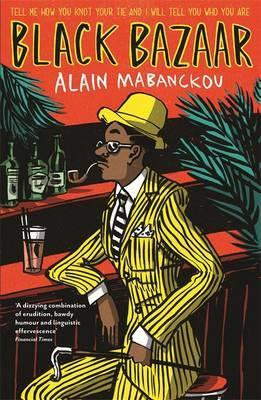 The narrator of the 2009 novel Black Bazaar (the English edition was released in 2012 by Serpent’s Tail and has been longlisted for the IFFP) is both a member of Les Sapeurs and, like it, an import from Congo-Brazzaville. He’s lived for over a decade in Paris. He goes by the name “the Buttologist” amongst his friends at Le Jip’s Bar for reasons that shouldn’t need to be explained.
The Buttologist is alternately writing and inhabiting events. His girlfriend, a French woman he calls “Original Colour”, has run off with a tom-tom player from a traditional music group. She’s taken their baby daughter with her. The Buttologist, left behind in the now empty studio apartment they once shared, buys a typewriter and sets about writing. He writes about what he knows. Giving voice not only to his own story, but to his friends’ and neighbors’ – immigrants who’ve all come to France from former French colonies in Africa, the Middle East and the East Indies. And (like a Tarantino film) almost every character in Black Bazaar gets a soliloquy in which to air their opinions – usually on the “colonial legacy”. These orators are invariably eccentric, cocky and deeply convinced that their view is the correct one. They deliver their speeches from atop the soapbox in pitch perfect dialogue. So perfect that it’s easy to imagine you’re eavesdropping from a stool at Jip’s. Mabanckou is not telling you about this world, he’s asking you to become a part of it.
I wondered why Haitians are either brilliant writers or taxi drivers for life in New York and Miami. And when they’re writers they are in exile. Do writers always have to live in another country, and preferably be forced to live there so that they’ve got things to write about and other people can analyse the influence of exile on their writing?…
…These Haitian writers are like hunted birds. They’ve had more than thirty-two coups d’état back home and not a country in the world has equalled this record yet. With each coup d’état, flocks of writers have emigrated. They left everything behind, setting out with nothing apart from their manuscripts and their driving licence. I wish I’d been born Haitian so I could be a writer in exile who understands the song of the migrating bird, but I don’t have any manuscripts, or a driving licence to become, in the worst-case scenario, a taxi driver in the streets of Paris …
Black Bazaar is filled with passages like this – delivered with haunting prose and a wry humor. Everything is taken in stride. The narrator and his friends are always adapting, without surrendering their sense of who they are. As a character tells him at the end of the book, “Above all, you must never forget your own country, never…”
Alain Mabanckou and the Buttologist have a lot in common. Both were born in Congo-Brazzaville. Both immigrated to Paris as a young men and spent a lot of time at Le Jip’s, a bar frequented by African expats on rue St. Denis. (The author currently lives in America, a country where his writing is disgracefully under-appreciated). And, like his narrator, Alain Mabanckou has written about what he knows. Whether he’s describing the African diaspora, the lives of Congolese immigrants in France and their conflicting opinions on the legacy of colonialism. Or explaining le Sappeurs or the music of Papa Wemba. He does it with warmth, and more importantly with authority. Alain Mabanckou is an author for who terroir is everything.
Publisher: Serpent’s Tail, London (2012)
ISBN: 978 1 8476 5657 5
*only available digitally
Translation Prizes – The Independent Foreign Fiction Prize
March 12, 2013 § 6 Comments
I always try to post updates on the more interesting literary awards – all the Man (International, Booker & Asian) Literary Prizes, the Nobel Prize for Literature, etc. But, as wonderful as those longlists tend to be, they seldom inspire the absolute, all-consuming, bank account-deflating, oh-my-god-where-am-I-going-to-put-more-books-I-don’t-care book lust as the lists I’m here to talk about today: The Best Translated Book Award and The Independent Foreign Fiction Prize.
Obviously, these are the books I enjoy reading – translations, international authors, and authors whose work you tend not to find on the B&N feature table. The one downside has been that, as a rule, I’ve been painfully ignorant of the books, authors and translators that have been nominated in past years. This year is different. I can actually intelligently give my opinion on some of these novels and authors!
The Independent Foreign Fiction Prize (IFFP) is a UK based prize, but even when the books aren’t available in paper format in the U.S. I’ve been able to find them digitally. It tends, in my opinion, to contain titles that are popular with general readers vs. the Best Translated Book Award which is, also in my opinion, heavily weighed towards the more esoteric books released that year by independant & small presses. I’ve only read two (and bought five) of the books on the 2012 IFFP longlist, so where I could find them I’ve linked to other bloggers’ reviews.
- Gerbrand Bakker: The Detour (David Colmer; Dutch), and published by Harvill Secker – review from ANZ Lit Lovers blog
- Chris Barnard: Bundu (Michiel Heyns; Afrikaans), Alma Books
- Laurent Binet: HHhH (Sam Taylor; French), Harvill Secker – review from BookSexy Review
- Dasa Drndic: Trieste (Ellen Elias-Bursac; Croatian), MacLehose Press – review from Winstonsdad’s Blog
- Pawel Huelle: Cold Sea Stories (Antonia Lloyd-Jones; Polish), Comma Press – review from Tony’s Reading List Blog
- Pia Juul: The Murder of Halland (Martin Aitken; Danish), Peirene Press – review from Winstonsdad’s Blog
- Ismail Kadare: The Fall of the Stone City (John Hodgson; Albanian), Canongate
- Khaled Khalifa: In Praise of Hatred (Leri Price; Arabic), Doubleday – review from Arabic Literature Blog
- Karl Ove Knausgaard: A Death in the Family (Don Bartlett; Norwegian), Harvill Secker – review by The Mookse and the Gripes Blog
- Laszlo Krasznahorkai: Satantango (George Szirtes; Hungarian), Tuskar Rock/New Directions in the U.S. – review by Three Percent Blog
- Alain Mabanckou: Black Bazaar (Sarah Ardizzone; French), Serpent’s Tail – review by Africa is a Country blog
- Diego Marani: The Last of the Vostyachs (Judith Landry; Italian), Dedalus
- Andrés Neuman, Traveller of the Century (Nick Caistor & Lorenza Garcia; Spanish), Pushkin Press – review by Charles Lambert Blog
- Orhan Pamuk: Silent House (Robert Finn; Turkish), Faber /Knopf in the U.S. – review by The Literary Outpost Blog
- Juan Gabriel Vásquez: The Sound of Things Falling (Anne McLean; Spanish), Bloomsbury
- Enrique Vila-Matas: Dublinesque (Rosalind Harvey & Anne McLean; Spanish), Harvill Secker – review by Asylum Blog
Of the two I’ve read: Laurent Binet’s HHhH is the more controversial book. Readers and critics either love it or absolutely hate it. I loved it and personally felt that James Wood’s negative review in the New Yorker – which, let’s face it, shaped a lot of readers opinions going in – spent more time on Wood’s problems with the author than it did on critiquing the actual book. It will probably make the shortlist, but I doubt it will win.
This is Alain Mabanckou’s second time being nominated – and I’m just finishing up Black Bazaar. I really enjoy Mabanckou’s books (and love saying his name out loud): they’re funny and smart. Because he’s been shortlisted once before I’m fairly certain he’ll make the shortlist again. Still, Black Bazaar is still a dark horse to win – if only because it’s lighthearted in comparison with past winners.
Of the books I haven’t read, Ismail Kadare is a favorite author. Unfortunately, The Fall of the Stone City is not available digitally in the states. And Bundu by Chris Barnard is definitely a book I’d be interested in. The plot involves drought refugees at a Mozambique aid station who hatch a desperate plan. I’m hoping to read it before the final winner is announced.
Have you read or reviewed any of the longlisted books? Share you thoughts and predictions in the comments!


