
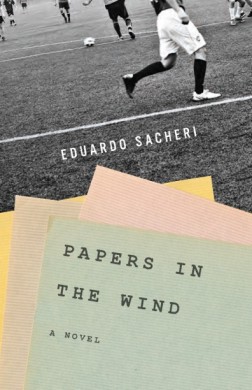
 The 2014 World Cup is almost upon us. Making it the perfect time to pick up a book about soccer - but nothing too technical. Something that taps into the passion of the fans, but doesn’t require that the reader be a fan herself. And, of course, it can’t be all about soccer. That would be a bit much for someone who has never watched an entire game in her life.
I think I’ve found just the thing.
Eduardo Sacheri’s first novel to be translated into English, The Secret In Their Eyes, was a taut and suspense-filled thriller. His second novel is something completely different. In Papers In The Wind Sacheri again returns to Buenos Aires, this time to tell the story of four childhood friends. When the youngest of their group, Alejandro “Mono” Raguzzi, dies of cancer his elder brother Fernando and best friends Daniel “Ruso” and Mauricio are devastated but determined to honor his memory.
A few years earlier Mono had used his entire life savings, $300,000.00, to buy a promising young soccer player. The player never lived up to that initial promise. And so after Mono’s death the normally level-headed Fernando hatches a scheme to sell the player and use the money to secure his niece’s, Mono’s daughter’s, financial future. What ensues is a picaresque-style comedy as the three men attempt – through all kinds of harebrained shenanigans – to make a star out of a Striker who is too big and too slow to score a goal.
And hilarity ensues, as they say. Papers In The Wind is very funny, but it’s also a book with immense heart. That strikes a nice balance, since the overall premise can seem a bit far-fetched at times. Eduardo Sacheri is an extremely talented writer whose characters are both perfectly, and imperfectly, drawn. Their flaws make them real. And as the story unfolds – both in the present and in flashbacks to Mono’s illness – you find yourself believing in these men. And in their friendship. And, subsequently, in their crusade.
The interactions between the friends, along with a huge cast of supporting characters (at one point a transvestite wanders into the story, bonds with Fernando and wanders back out again purely for the fun of it), provides a nuanced portrait of friendships between men. Women, with the exception of Mono’s daughter Guadalupe, exist only on the periphery of this masculine microcosm. The action bounces between present day – with Fernando, Ruso & Mauricio desperately trying to sell the Striker while still grieving the loss of their friend & brother – and flashbacks to Mono’s illness. In the flashbacks the men bicker and laugh and support each other in ways we’ve been conditioned to expect only from female characters. It’s still a novelty to see this kind of tenderness depicted in men.
Admittedly, where some of that tenderness is directed may seem a little strange to the uninitiated. Mono has a tendency to wax philosophic on life and fútbol, and his love for the fútbol club Independiente (a.k.a.the Red)* borders on religious fervor. In one scene Fernando promises his brother that he will make sure that little Guadalupe grows up an Independiente fan, despite the fact that the club’s glory days have long been a thing of the past.
“You don’t have to worry, Mono.”
“About what?”
“She’s going to be an Independiente fan. The rest of it I don’t know. I mean, about the cups and the mystique, I can’t say for sure. Maybe it comes back, maybe it doesn’t. But we’ll get her to root for the Red.”
The romance attached to a favorite team or sport might be difficult for non-fans to understand. Except, caught up in the world of Sacheri’s characters, it isn’t difficult at all. Moments like the one aboveare incredibly touching. Fútbol and Independiente become metaphors for something else. What that something else is: faith, friendship, life, loyalty, tradition… I don’t think it really matters. The power  lies in the attachment. And different readers will take away different things.
Papers in the Wind, and Sacheri, are at their finest in the moments when the main characters are together – the dialogue is a joy to read and the timing is impeccable. Sometimes Sacheri takes two or three chapters, interspersed between other chapters, to get to the punchline of some joke. Leaving readers giggling along with Mono, Ruso, Fernando & Mauricio like little kids. And he provides enough twists and surprises throughout to remind his readers that his last book was a thriller. Papers in the Wind, like The Secret In Their Eyes before it, is an extraordinarily well-crafted novel. Disarmingly entertaining; wonderfully nuanced – it’s clever without showing off. Like a great soccer player, Eduardo Sacheri manages to make what he does on the field appear easy for the fans.
Publisher: Other Press, New York (2014)
ISBN: 978 1 59051 642 3
*A little background: Independiente was one of the great Argentine fútbol clubs until the 1980’s when a began its slow but steady decline. Prior to that period Independiente won a number of international titles, had the first fútbol stadium in Latin America and was considered one of Argentina’s premier fútbol clubs. In the 2013-2014 season, after 101 consecutive years as a Division One team, it dropped into second division for the first time in the club’s history.
 What kind of writer eviscerates his own novel? What drives a person to that extreme? And – just so we’re clear – we’re not talking about paring down the prose or making a few surgical edits to tighten up the plot. Carlos Labbé rips out entire chapters of his book and leaves huge, gaping holes behind. That takes guts. When it works it’s exciting and innovative. And, yes, disturbing. When it doesn’t it’s frustrating and… well it’s frustrating.
