
A New Ol’ Girls Club

The blogger Biblibio posted a call to arms in this December 9th post Where In the World Are Women Writers?  and the follow-up Women in translation – responses.  After informally crunching the numbers he/she came to the conclusion that less than 30% of the literature translated into English is written by women.  After reviewing my reading history I came up with results that were startlingly similar.   Leading to the obvious question:  What the hell is going on?!

I can’t speak for the publishing world as a whole, but I can unequivocally state that I do not seek out male over female authors.  Keeping that in mind I went back and tried to determine how the books I read this last year first came to my attention.  The result was a mixed bag of publishers, podcasters, book critics, bloggers, booksellers and Goodreads.  In other words, useless.

But, just when I was getting my indignation on in defense of the feminine gender, it was brought to my attention by a recent episode of the BBC Radio 4 Open Book Podcast that the majority of literary prizes in English for 2012-2013 were won by women authors.  Alice Monro (Nobel), Hilary Mantel (too many to list), Lydia Davis (Man Booker International), Eleanor Catton (Man Booker), Angela Jackson (Edinburgh Festival First Book)… you can see the entire list on the Open Book website.  In fact, women have made a strong showing overall on the long and short lists of all the major English language literary prizes this past year.

Obviously, this doesn’t in any way refute or reverse Biblibio’s findings.  Yet it does reinforce my belief that this disparity is not happening intentionally.  Publishers care about selling books and publishing good literature (hopefully not in that order).  It’s doubtful that they have any investment (emotional or otherwise) in an author’s gender.  My hope is that what we are dealing with is residual gender bias from the 20th century… a habit easily kicked if readers are willing to make the effort.  And more importantly, if those of us who review are willing to get the word out.  Because if they sell publishers will take notice.

Case in point:  who knew that the Scandinavians were so into crime (or, let’s face it, could name the 3 Scandinavian countries off the top of their head?) before The Girl With the Dragon Tattoo?

Now, I realize that in some circles “quotas” is a dirty word.  But they have frequently been proven effective.  So I propose this informal challenge to fellow readers, bloggers and reviewers:  in 2014 challenge yourself to read a set number of books in translation written by women – and then review them.  The review part is key.  Whether on a blog, as a contributor to a traditional media outlet or on Goodreads it’s important to give these authors a little marketing nudge.

Hmmm… this could merit a hashtag.  Something I’m terrible at.  Anyone?

This year my personal goal is to read and review 52 books – one per week.  Half by women.  I intend to alternate – every book by a male author will be followed by a female author, and vice versa.  With a modicum of planning this shouldn’t be difficult to implement.

Until I started actively seeking books in translation I had no idea of the incredible literature from around the world I’d been missing out on.  Now I look at my bookshelves and see authors whose names, three years ago,  I didn’t know.  I can’t wait to see who gets added in the year ahead.
Two Short Works of Non-Fiction by Readux Books

Whether or not you subscribe to the theory that the digital age is creating an ADD society (there was a great article about this last month in The Guardian) time is at a premium in today’s world and there’s no arguing the attractions of shorter fiction.   Earlier this year I ran a series of posts featuring bloggers discussing why they love – or hate – short stories.  Novellas are also growing in popularity. Readux Books, the new publisher based in Berlin, has hit the sweet spot somewhere between the two with the release of their first collection of books this past October.
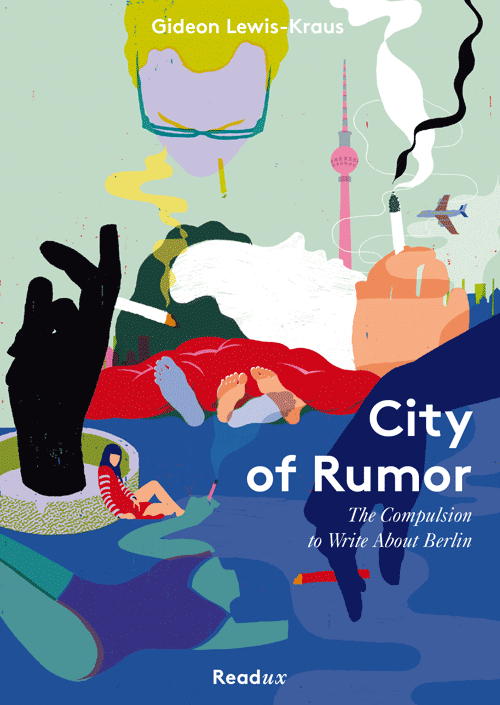
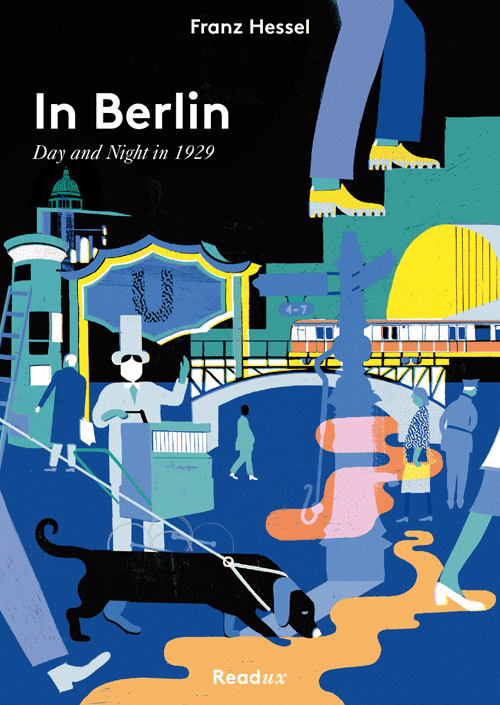
A lot of care has obviously gone into the making and launching these books.  Each is approximately 5,000 to 10,000 words – a length Readux feels is in keeping with “reading habits in the digital era, without room for slack, but that is long enough to allow complex themes to be developed.”  The gorgeous, brightly colored paperback covers referencing the German Expressionists.  The writing is experimental – of the four books, three are translations – yet accessible.   Readux has obviously made clever choices and taken some calculated chances in the planning stages.    And while each of the four books is sold individually, they share common themes, ideas and a consistent packaging that had me coveting them for my bookshelves.  This careful curating reminds me of some of my favorite independent publishers: New Directions, Open Letter and Other Press.

The two non-fiction titles are memoirs about life in Berlin, written from two different periods in the city’s history.  Yet, the Berlin described appears remarkably unchanged despite an 85 year gap in the timeline.  The changes in writing styles are much more drastic.  Franz Hessel’s In Berlin: Day and Night in 1929 lacks the post-modern trappings of City of Rumor: The Compulsion to Write About Berlin (written by Gideon Lewis-Kraus in 2013).  The former is a period piece that is similar to Christopher Isherwood’s Berlin Stories.  Not surprising, as both he and Hessel lived in Berlin at the same time.  It’s not unthinkable that they would even have traveled in the same circles.

Hessel was a Jewish editor, author and translator.  He was a member of the German artist community.  His complicated marriage to the journalist Helen Grund inspired Henri Pierre Roche’s novel Jules et Jim (which, in turn, inspired the 1962 François Truffaut film of the same name).  Eventually, he would flee Germany for France and he and his son would be sent to an internment camp.  He died in 1941, the same year he was released from the camp.

But here Hessel is writing about the heady days before the tragedy of WWII.  His descriptions of Berlin and its citizens are frenzied and entertaining.  In Berlin is an all too brief excerpt of what I believe must have been a longer piece in which we readers get to follow Hessel and his companions as they drift between cabarets, parties and clubs. We meet the German equivalent of Flappers and get a taste of the sexually progressive atmosphere that permeated the city at that time.  The sharp, witty prose style is characteristic of Lois Long’s column for the New Yorker during the same period.

… Gert and Maria deliberate on what else we could undertake to do. “Why don’t you young people go upstairs and dance?” I ask.  “I don’t want to,” says Maria, “but maybe Gert would find some companionship in the Blaue Salon.” “Actually I was supposed to stop in to Ambassadeurs today at midnight.”" In my inexperience, I am informed that this is the newest extension of the Barberina.  Gert and Maria then discuss the quality of the various jazz bands and tango groups in the big hotels, in the Palais am Zoo, in the Valencia, etc.  I somewhat timidly introduce my experiences from the little Silhoette.  “why don’t we just go across the way here to Eldorado?  That’s where the real bedlam’s at.  You’re all for chaos, smoking and sport jackets, transvestites, little girls, and great ladies, aren’t you?  Of course you’re more for what’s proper, Gert, you want elegant dancing and limits, you want to go to Königin.”  But in the end we decide on something completely different.

If you’re in Germany you can buy a set of (4) posters featuring Readux covers.

In contrast, City of Rumor by Gideon Lewis-Kraus spends less time writing about Berlin, the city, and more on his conflicted emotions regarding it.  He is a modern-day expatriate.  Lewis-Kraus is an American journalist whose work has appeared in Harper’s, GQ, The New York Times Magazine and the London Review of Books.  His writing is as beautiful as Hessel’s, but also more fraught. The modern Berlin he describes is still a frenetic party scene, but seems less innocent and more world-weary. The essay, itself, reads much more self-indulgent; the main conflict being internalized.  Berlin assumes the secondary role, stripped of its unique character and becoming interchangeable with cities like Brooklyn, London or L.A.   “Hipster” is a word that comes to mind.   “Angst” is another.  Of course, the subtitle is “The Compulsion to Write About Berlin“, – so you could say that Lewis-Kraus has delivered on what was advertised.

The chapter about Berlin, like the lives of man of the people I knew in Berlin, had no such constraint – no relevant chronology, no narrative necessity. When I sat down to write about Berlin for the first time, all I could do was make a list of anecdotes, the ones that had lingered with me for some reason, in no particular order.  I wrote them out as a series of disordered episodes – the time we followed the votive candles to the rave in the toolshed in the middle of the park, the time our friend held a real art opening outside a fake art opening – and saw little use or accuracy in connecting them.  After all, they had only ever felt associatively connected in the first place.  They had, or course, happened in one particular order, though as far as I could tell they might very well have happened in any other order, or no order at all.

Side-by-side these essays seem not about Berlin but instead about two generations of young urbanites.  That contrast between authors is what I found most interesting.  Individually they’re entertaining reads – but considered together they have the potential to spark a larger conversation about historical, cultural and literary changes.

The two fiction titles are Fantasy by Malte Persson, translated from Swedish by Saskia Vogel and The Marvel of Biographical Bookkeeping by Francis Nenik, translated from German by Katy Derbyshire.

Publisher:  Readux Books, Berlin

In Berlin: Day and Night in 1929
ISBN:  978 3 944801 01 8

City of Rumor: The Compulsion to Write About Berlin
ISBN:  978 3 944801 03 2

Add to FacebookAdd to DiggAdd to Del.icio.usAdd to StumbleuponAdd to RedditAdd to BlinklistAdd to TwitterAdd to TechnoratiAdd to Yahoo BuzzAdd to Newsvine