To Salinger, With Love & Squalor

SalingerOn September 6th a documentary on J.D. Salinger, called simply Salinger, will be released in theaters. For Salinger fans this is a big deal.  The television rights have already been sold to PBS.  A book full of photographs will be in stores September 3rd.  Those attending advance screenings of the film, or who have been given access to the book, have signed non-disclosure agreements.  Of course, tons of information has leaked out.  (You have to wonder how Salinger managed to keep his secrets for decades, when the Weinstein’s couldn’t manage it for a few weeks).  That Salinger was in the intelligence service during WWII, possibly suffered from Post Traumatic Stress Disorder, was a jerk to the women he dated (well, that wasn’t necessarily news) and that we may be seeing new works in the next 5 years -  has all been revealed over the past weekend. So I’m looking forward to seeing the actual film next week if only to find out what surprises – if any – are left.

Reading The Cather in the Rye was not a world altering event for everyone.  Some of us prefer Salinger’s short stories – particularly those about the Glass family.  After reading Nine Stories; Raise High the Roofbeams, Carpenters and Seymour: An Introduction; and Franny & Zooey I was so enamored that I spent a ridiculous amount of time trying to get my hands on anything he’d ever written. What did I discover?  That there wasn’t much out there to discover.  Some uncollected short stories on microfiche at the New York Public library; a copy of The Way of the Pilgrim (the source of the Jesus Prayer that Franny takes up in Franny & Zooey);  In Search of J.D. Salinger, a.k.a. – Ian Hamilton’s Hail Mary attempt to see a return on years spent researching the Salinger biography he wasn’t allowed to publish; and a small 1960′s paperback collection of essays on Salinger’s work (more on that later) discovered in a second-hand shop.

I had and have no interest in reading Joyce Maynard’s memoir. I’m still on the fence regarding the book written by his daughter.

I also haven’t read Kenneth Slawenski’s 2011 biography J.D. Salinger: A Life, which came out long after I’d resigned myself to waiting patiently for the subject’s death.*  (I made the calculations… being 55 years younger than Salinger, barring a horrible accident, the chances were pretty good that I’d live to see the posthumously published works).  And, anyway, I was never really interested in learning about J.D. Salinger the man.  I wanted more of the Glass family.

The 1963 collection of essays, edited by Henry Anatole Grunwald and entitled simply Salinger: A Critical & Cultural Portrait, is the book which provided the foundation of my Salinger research.  Originally published by Harper & Row in 1961, mine is the small Pocket Books paperback edition. It includes a number of essays published by the likes of John Updike, Alfred Kazin, Joan Didion and contains an introduction by the editor.  It was from this little book that I learned about Hapworth 16, 1924, the last short story Salinger ever published.  It’s a strange little story (which I can’t imagine the magazine agreeing to publish if the author hadn’t already received so much critical attention) that takes the form of letter home from camp written by a young and precocious Seymour Glass.   Salinger: A Critical & Cultural Portrait also contains the TIME magazine article which states that “a friend reports that Salinger intends to write a Glass Trilogy” and provides a brief overview of Salinger’s military career – a period Slawenski’s biography seems to have covered and the new documentary expands upon.  Less exciting (for me) was the information that the Caulfield family had a cycle of short stories, similar to the Glass family which were cannibalized and consumed by The Catcher in the Rye.  There are about four of these – two only accessible to the public through Princeton University Library – and they all seem to contain major discrepancies from the final novel: name changes, variations on the cause of Holden’s younger brother’s death (heart condition, drowning, and finally leukemia) and some timeline issues.  For Salinger the two families, Glass and Caulfield, were a constant work in progress.  He couldn’t let them go.

The fact that Salinger continued to write in isolation shouldn’t be a surprise to anyone with even a passing interest in the author.  The real surprise would have been learning that after all these years of waiting he had left behind no manuscripts whatsoever.  Or that he’d left instructions to burn the manuscripts.  *shudder*  Rumors of his continued work have been persistant.  Even my little 1963 paperback mentioned House of Glass – the supposed working title for the epic Glass family history that’s apparently been years in the making.  So the New York Times article published over the weekend regarding the release of new works between 2014-2020  is mildly exciting – but for those of us who have been waiting patiently it raises a lot of questions. 

If David Shields, Shane Salerno and Slate.com are to be trusted, and there’s no reason at this point to believe otherwise, we have confirmation that there are 5 books and instructions as to when they are to be published.  And that among these manuscripts is a novel The Family Glass.  But how much of the work will be entirely new?  Is this novel a re-working of the early Glass stories – like what happened with Caulfield stories in the writing of The Catcher in the Rye - or a continuation?  We’re also told that there will be more stories featuring members of the Caulfield family. We’re told definitively that these will include new stories, as well as the re-packaged older stories. Have the continuity issues been resolved or will they be preserved?

Which leads to the next logical question:  who will act as editor?  Considering most of the famous short stories were published in The New Yorker and edited by William Maxwell this is of real interest to fans.  Or it should be.

OK, I lied.  This is all more than mildly exciting.

It’s been three year since J.D. Salinger died and I’m still making mental calculations.  If the timeline is right I’ll be under 50 when the last of the new books is published. Hapworth, 16, 1924 appeared in The New Yorker close to a decade before I was born.  I’ve been waiting since I was 14 years old for a new book or story to see the light of day.  That seems strange. (“Sad!” my husband says, looking over my shoulder). And inexplicable. Because I’ve read better authors. There are plenty of books out there with more sophisticated plots. Yet I continue to love Salinger’s stories.  I still want to know what happens to the characters.  So do a lot of other people! (I yelled that last bit back at my husband).

If you’re one of them I’d love to hear why. Are you planning to see the documentary? Are you Team Glass or Team Caulfield? If you’re looking forward to new books and stories, do you have any expectations? Or do you think Salinger was a big phony? Comments are open below… and it looks like we have at least two more years to fill them.

Add to FacebookAdd to DiggAdd to Del.icio.usAdd to StumbleuponAdd to RedditAdd to BlinklistAdd to TwitterAdd to TechnoratiAdd to Yahoo BuzzAdd to Newsvine

*Don’t you judge me!

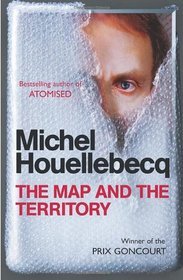
The Map and the Territory by Michel Houellebacq, translated from the original French by Gavin Bowd

10099407

This is the cover from the British edition, published by William Heinemann. I bought the book after hearing about the cover. It’s not wrapped in real bubble-wrap (like I believed) but the image of the bubble wrap is embossed and the end papers are bright red. Altogether a beautiful book.

It’s easy to see why Michel Houellebecq inspires strong emotions.  It takes a special kind of arrogance to write yourself into your own novel as a central character.  And then there’s the annoying idiosyncracies – the politically incorrect rants he seems to revel in, his love of obscure bits of information or penchant for italics (which implies an insulting lack of faith in his readers sophistication).  But perhaps most damning is the way the man writes. As if he’d met with the devil under the Arc de Triomphe and signed over his soul at the stroke of midnight.  Houellebecq is that good.  Worse yet, he knows it.

The Map and the Territory won that famous French literary prize, the Prix Goncourt and popular opinion seems to rank it as among the least offensive of Houellebacq’s novels.  It is the story of the life and career of  Jed Martin, a successful French artist who is unusual in that he works in a variety of mediums – photography, painting and video.  Jed is an artist in the vein of Howard Roark, – so intensely engaged by the process of creating that he is unable to form or maintain meaningful human relationships.  Their problem is not that they are unable to feel emotions or attachments, but that they lack any real interest in doing so.  Such is Jed’s existence until he reaches out to the French author Michel Houellebecq.  His gallery wants Houellebecq to write the program for Jed’s upcoming show, and Jed offers to paint Houellebecq’s portrait in return.  A strange intimacy (or what passes for intimacy for these two) develops between the two men.  An intimacy Jed hopes will develop into friendship.  That hope is disappointed in Part Three of the novel when Houellebecq is unexpectedly and gruesomely murdered.

A moment, please, to savor the irony of Michel Houellebecq writing a book about two men who do not play well with others.

Despite the jacket copy, The Map and the Territory is not a thriller.  Nor would I call the book “playful” (also found in the jacket copy. This is a thoughtful, intelligent novel in which a lot happens without anything seeming to .  Jed’s quiet existence and intense laser-focus on his work is completely incongruous to our current age of increasingly frenetic distractions.  He exists in an existential vacuum and over the course of his life producing only three bodies of work.  First a series of black & white still-life photographs of tools; second a series of paintings of tradesmen, which morph into portraits of celebrity businessmen and artists (including the portrait of Houellebecq and one of Jed’s father);  and finally time-lapse videos recording the disintegration of photographs exposed to the elements.  They are pictures of his friends and family.  The works of art are perhaps the most interesting things about Jed.

She looked at him again, more intently, for at least five seconds, before saying: ‘I find it very beautiful.’

She had said that simply, calmly, but with real conviction.  Incapable of finding an appropriate reply, Jed turned back towards the image.  He had to agree that he was, in fact, quite happy with it himself.  For the exhibition he had chosen a part of the Michelin map of the Creuse, which contained his grandmother’s village.  He had used a very low camera angle, at thirty degrees from the horizontal, while setting the tilt to the maximum in order to obtain a very high depth of field.  It was then, by using Photoshop layers that he had introduced the background blurring and the bluish effect on the horizon.  In the foreground were the pond at Breuil and the village of Châtelus-le-Marcheix.  Further away, the roads winding through the forest between the villages of Saint-Goussaud, Laurière and Jabreilles-les Bordes appeared like a dream territory, fairy like and inviolable.  In the back-left corner of the image, as if merging from a bank of mist, the white-and-red ribbon of the A20 motorway could still be made out clearly.

‘Do you often take photos of road maps?’

“Yes… Yes, quite often.’

‘Always Michelin?’

‘Yes.’

She pondered this before asking him: “Have you made many photos like this?’

‘Just over eight hundred.’

All of this is in direct contrast to the character Michel Houellebecq – a man who delights in random bits of information and makes desperate lunges at happiness.  On first meeting him, Jed discovers a dirty, drunken little leprechaun of a man.  Towards the end of the book, prior to his murder, Houellebecq seems to be pulling himself together.  He starts bathing, supplements his liquid diet with real food and buys a dog.  He retires to his family home in the country.  While he isn’t what I’d call a role-model, he certainly is the more entertaining character.

The first two parts of The Map and the Territory (over half the book) deal with the rise of Jed’s artistic career and his relationships.  The third part deals almost exclusively with Houellebecq’s murder and the detective assigned to the case.  The entire novel is written in the third person.  It is my favorite narrative perspective.  The first person focuses on character, second person targets the reader, but it is the third person that allows the reader to approach the author and observe him at works. It is the voice of god, a.k.a. the author. For that reason it has always seemed to me the way of telling a story that relies the least on artifice and gimmicks in order to engage readers.  And because it is less caught up with an individual character’s development, it creates the space to deal in big themes – something Houellebecq seems to delight in.  Along with a gallows humor, the author appears to be something of a nihilist.  Everything that occurs in The Map and the Territory trends towards the mercenary (regardless of characters’ intentions).  Art, love, filial relationships, murder – nothing is pure.  While this is a fascinating, beautiful and cerebral novel, it is not a particularly comforting one.

It bears mentioning that French Slate published an article about The Map and the Territory on its release, accusing Houellebecq of plagiarism.  The article showed that some of the factoids –  the mating habits of a species of ants is the example cited – are lifted almost verbatim from French Wikipedia.  Houellebecq claims that his “approach, muddling real documents and fiction” is all a part of his process and that there never an attempt to mislead readers.  I believe him.  Houellebecq is too talented a writer and the examples too prominently placed for plagiarism (if we define plagiarism as an attempt by an author to represent another’s work as his own) to be plausible.  Plus, the inference is that an author steals because he believes the plagiarized work is somehow superior to his own.  From all reports Houllebecq’s arrogance shatters that possibility.  In the English edition of the book he goes so far as to thank Wikipedia in the acknowledgements.

This, along with a long list of other controversies and accusations (pornography, racism, anti-Islamic comments, misogyny, etc.) is what makes Houllebecq a difficult person to like or admire.  Many critics seem to despise him.  Which begs the question:  Do we need to like, admire or even agree with an author in order to acknowledge his ability as a writer or to enjoy his book?  And if we enjoy the book does that somehow make us complicit in the opinions and actions, or must we be automatically sympathetic to the characters, we are reading about?  I bring these questions up in relation to Houellebecq because they are very relevant to his work – at least critics have tried to make them so.  Controversies are easy to write about at length, whereas what is there really to say about his writing?  If The Map and the Territory is representative of his other work – then it is, simply put, flawless.

Publisher: William Heinemann, London (2011)

ISBN:  978 0 434 02140 6

Add to FacebookAdd to DiggAdd to Del.icio.usAdd to StumbleuponAdd to RedditAdd to BlinklistAdd to TwitterAdd to TechnoratiAdd to Yahoo BuzzAdd to Newsvine