
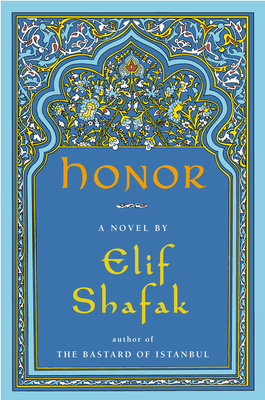
Honor or Iskender by Elif Shafak

HonorElif Shafak is an author I’d been meaning to read.  Her novel, Flea Palace, has been sitting on my shelf for a long time.  So it’s mildly surprising that when I finally picked up one of her books it wasn’t Flea Palace but her newest novel – titled Honor in America & the UK… and Iskender everywhere else.

The writing is enchanting.  Let’s get that out of the way up front.  Elif Shafak has a beautiful, lyrical prose style that dazzles.  She’s a writer who pirouettes across the page, defying gravity and making it look easy.  It’s all very impressive.  At any second you expect her to cross the line – for the writing to become overdone, weighed down by flourishes, burdened by poetic imagery.  Yet that never happens.  She uses just the right amount of restraint.  Shafak embraces, but isn’t limited by style.

It helps that she has a preternatural ability to shift between characters  -  creating distinctive personalities and channeling the voices of men and women from a variety of backgrounds.  We’re allowed to inhabit their thoughts, and then to observe from the outside as they interact with each other.  Often within the space of a few paragraphs.

Iskender (the title I prefer) is the story of a Kurdish family that emigrates from Turkey to London in the 1970′s.  But Elif Shafak begins her plot a little before that in the rural Turkish village where the mother, Pembe, and her twin sister Jamilla live.  A young man named Adem visits and falls in love with Jamilla, but is told she is promised to another man.  And so he marries Pembe.

From the beginning the union is doomed, but Adem and Pembe have three children nonetheless.  The eldest son is named Iskender, the middle daughter Esma and the youngest (another son), Yunus.   The children acclimate quickly to England.  Their parents less so.  Adem begins gambling and takes up with a woman – who seems to work as an escort in the gambling den he visits – and deserts his family.  Pembe begins a friendship with a man named Elias who she meets secretly in old movie theaters.  Esma and Yunus have their own stories.  It is Iskender, an arrogant young man who is drifting towards radicalization, who stabs and kills his mother on learning that she is seeing a man.  It is an honor killing.  When the book begins Iskender is in prison.

That is the skeleton of the plot.  Onto it Shafak applies layer after layer of family dynamics, cultural identity and psychology.   Add to this  her beautiful prose and it’s hard not to fall in love with this book.  But Iskander has a weakness: the OCD attention to pivotal details.  I’m not exaggerating.  Shafak has the plot of her novel so tightly put together that you can hear the chapters clicking into place as you turn the page.  There is no minor detail in this book, so pay attention!  Actually, you could probably not pay attention and still not miss a thing.  Elif Shafak seems to be an adherent of Nabakov’s galley slave philosophy when it comes to “free will” for her characters and her readers.

Which is why Iskender is, on final examination, it too perfect a story.  Its author, you realize at the end, has a narrative agenda.  There’s a place Shafak intended to take her reader and she  carefully laid out the path to get there.  You are not encouraged to stray from that path. You are, instead, being moved from plot point to plot point to conclusion – with no ambiguity.  Suddenly those pirouettes seem less effortless and more practiced.

The last chapter of Iskender disappoints.  The plot twist, which isn’t entirely a twist, twists back on itself – becoming both emotionally manipulative and necessary only to the author.  Of course I won’t give the ending away, partly because up until I reached it I loved Iskender.  I was able to buy into these characters… until I didn’t anymore.

Publisher: Viking, New York (2013)
ISBN:  978 0 6707 8483 7

Scars by Juan José Saer, translated from the original Spanish by Steve Dolph

http://catalog.openletterbooks.org/images/covers/scars_highres.jpgOf all his novels and short stories, it is For Whom the Bell Tolls that showcases Ernest Hemingway’s signature brand of maudlin, alcohol-soaked sentimentality.  Yet it remains a great novel.  The closing paragraphs, as Robert Jordan says goodbye to his María, are among the most heartbreaking ever written. Yes, I believe it would have been better if Hemingway had just written their conversation in Spanish instead of inflicting all those English thees and thous on readers.  Yes, there is something weird about his choice of the nickname Rabbit.  But the bleakness conjured by the words “We will not be going to Madrid…” has remained with me, as I imagine it has with others.

The famous epigraph that gives the book it’s title, taken from John Donne’s XVII Meditation can be attributed to Hemingway’s cynicism or prescience depending on your feelings about the man.  It ends with his hero, who valiantly aligned himself against the Fascists in the Spanish Civil War, lying beneath a tree and waiting to die.  We know the Fascists, Franco’s Nationalists, ultimately win – and in doing so unlatch the gate for the coming of the second World War.   “No man is an Island, intire of it selfe; every man is a peece of the Continent, a part of the maine; if a Clod bee washed away by the Sea, Europe is the lesse, as well as if a Promontorie were, as well as if a Mannor of thy friends or of thine owne were; any mans death diminishes me, because I am involved in Mankinde; And therefore never send to know for whom the bell tolls; It tolls for thee.”

Juan José Saer has set his novel, Scars, in a completely different time and place.  “La Zona” is Saer’s personal Yoknapawtapha.  It includes the city of Santa Fé, Argentina, c. the late c. 1960′s.  The books is divided into four parts.  How Saer names his parts is unusual – he uses it to compress the timeline.  Part one is February, March, April, May, June; part two is March, April, May; part three is April, May and part four is simply May. The common factor of all four narratives is a violent murder which takes place in May (the description of which is the last narrative in the book).  Luis Fiore kills his wife, La Gringa, by shooting her in the face with a shotgun. Twice.

The final part of Scars tells the story of the murder from the murderer’s perspective.  The preceding three parts only touch on that event.  Or rather, the event touches on the lives of the three men who each act as first person narrators for a section of the book.  It opens with Ángel Leto, who is a young journalist given access to Fiore by the judge on the case.  But of the 90 pages that make up Leto’s story only 7 pages and a few scattered sentences talk about Fiore or the murder.  The rest is taken up by/with Leto’s libido as he goes about his day-to-day business.  All his interactions are underlaced with an uncomfortable sexual tension.

The parts/chapters which follow are told from the perspective of an attorney and former friend of Fiore who has given himself over entirely to the game of Baccarat – spending all his money, mortgaging his house and taking the wages of his young housekeeper in order to continue gambling; and by the judge who presides over Fiore’s case – a man in a deep depression who sees the world through the narrow tunnel of his daily routine and perceives his fellow human beings as gorillas.  Lust, addiction, despair and rage – these are the drives each man’s life seems to be reduced to.  One at a time we, the readers, are trapped in an individual narrator’s head… along with his particular demon. Each of these men are connected, tenuously perhaps, by the murder.  And each is isolated, living self-absorbed lives in which everyone around them is a supporting character.

Scars is an early novel – by a writer who is considered by many to be one of Argentina’s  most important and influential authors.  As such it has it’s strengths and weaknesses.  The writing feels intentionally claustrophobic.  Steve Dolph has done a wonderful translation – somehow balancing the author’s obsession with the repetition and minutiae of his characters’ lives (a detailed explanation of the game of craps, for example), with incredibly subtle moments of true poignancy.   The Hemingwayesque styled conversations, particularly, are powerful because the prose is so stripped down.  Saer doesn’t even bother with quotation marks.

They’ve told me you live off gambling, said el Negro.

Just the opposite, I said.

Then I asked him to tell me about Fiore.  He said that he had gone hunting in Colastine Norte with his wife and their girl.  In the truck from the mill.  That on the way back they stopped at a bar.  There was an argument, and when they were leaving he shot her, twice.  I asked if the argument had been violent.  He said he didn’t really know.  He said that he had used the shotgun.

That could actually help, I said.

They’re going to give him twenty years, at least, said el Negro.

He’ll be comfortable in prison, I said.  Much more than on the outside.  It’s always more comfortable in prison, in a way.

El Negro stared at me.  The skin on his face was thick and taut.  Two cords curved from the base of his nose, dropped to the corners of his mouth, and died at his jawline.

I never thought I would find you like this, said el Negro.

Come on, Negrito, I said.  We go back.  Tell me what you can, because I’m not asking out of curiosity.

Scars ends with a postscript; the Latin words “NAM OPORTET HAERESES ESSE”.  This translates to “There must be heresies” which is actually only a partial quotation of 1 Corinthians 11:19.   The full line reads:  “For there must be heresies among you, that they which are approved may be made manifest among you”.  The word heresies is sometimes translated as heretics, or as divergent sects.  The translator Heather Cleary wrote a wonderful article on Saer for the website the Quarterly Conversation  entitled The Geometry of Dissent – in which she translates HAERESES to mean heresies or divergent sects.  Saer’s plays with points of view and perceptions, allowing the story of the murder to unfold slowly as the book progresses until, at the very end,  we are allowed inside Fiore’s head (though clear answers still aren’t given).  This makes sense, though to be honest I don’t see much divergence in the facts of the case among the narrators.  Another interpretation that seems equally legitimate is “heretics”.  That these four men, each sunk in a particular vice, likeable but by no means good, are in a way the heretics.  That their miseries, obsessions, addictions are all necessary to better see (and appreciate) a life better lived.  Because, going back to Hemingway, the only way to make someone understand that no man is an island is to show him that he, in fact, is.  That we are all trapped alone in our heads*, wrapped up in our own lives and egos.  Grace is the opportunity to step outside of ourselves and be “involved in mankind”.   Juan José Saer seems to have understood that… though his characters may not.

*have you ever read a Hemingway character who wasn’t trapped in his head??

Publisher:  Open Letter Books, Rochester (2011)
ISBN:  978 1 934824 22 1

Add to FacebookAdd to DiggAdd to Del.icio.usAdd to StumbleuponAdd to RedditAdd to BlinklistAdd to TwitterAdd to TechnoratiAdd to Yahoo BuzzAdd to Newsvine