“Every day, a little boy or a little girl swallows a noodle called Auguste Diodon,” the woolly crab explained to me. “It isn’t natural, and it makes me terribly ill at ease.”
“Me too,” I said.
“We have to save Auguste Diodon,” said the wooly crab.
“Let’s go,” I said. “How do we do it?”
- from In the Time of the Blue Ball
Antoine Volodine is an enigmatic French author… at least for those of us who can’t read French. I’m sure for those fortunate enough to understand la langue française he’s an open book, having written a prodigious amount of prose in that language under several pseudonyms (which include Lutz Bassmann, Elli Kroneauer and Manuela Draeger). In addition to writing fiction, Volodine (which is another pseudonym – this author’s true identity remains a secret) also translates Russian texts into English (though some seem to believe the Russian authors he translates are pseudonyms, as well). He is the creator of a literary movement that called “post-exoticism”, of which he seems to be the sole member. As best I can tell, post-exoticism is a kind of world-building – immersing the reader in a future, dystopian world; whose inhabitants speak a language that is almost but not quite recognizable as French; and where the borders and nationalities with which we are familiar no longer exist. Put succinctly – Antoine Volodine writes very complicated and very literary science fiction.
The keystone, Rosetta Stone if you will, of his body of work seems to be the novel Post-Exoticism in Ten Lessons, Lesson Eleven – sadly still waiting to be translated into English. From it readers learn that Volodine’s cache of imaginary authors are also exist as characters in his books. The conceit being that they are all prisoners in the post-apocolyptic future where their stories are set. For example: Manuela Draeger, who writes young adult novels and is the author of In the Time of the Blue Ball, is “a librarian in a post-apocalyptic prison camp who invents stories to tell children in the camp. This background is not indicated on the French editions of Draeger’s books, which are enjoyed by young people and older people alike;”*.
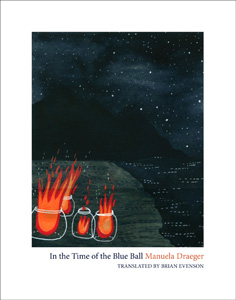
The three stories by Manuela Draeger collected In the Time of the Blue Ball (translated by Brian Evenson) and published by Dorothy, A Publishing Project are unlike anything I’ve ever read. The hero of these gorgeously surreal fairy tales, the boy named Bobby Potemkine, is a kind of detective. He has a dog named Djinn who plays the nanoctiluphe in a band of flies. Their friend, a giant wooly crab, is named Big Katz. When Big Katz comes to visit he brings the ocean with him. Bobby is in love with a bat named Lili Niagara (quick aside: all females in these stories share the surname Lili). The adventures of this group of friends are oddly whimsical. At the same time the feel gritty. Draeger somehow infuses a dark beauty – a post-exoticism version of magical realism – into the grey and miserable landscape that (I assume) runs throughout all of the post-exoticism novels.
This landscape is definitely a part of We Monks & Soldiers by Lutz Bassman (translated by Jordan Stump). Bassman works to engage all his reader’s senses from page one. The book opens with the words
{Constant drumming. Silence during the text.}
These two sentences act as a trigger, preparing the reader to step into an environment that is fundamentally different. Divided into 7 parts, really 7 short stories, We Monks & Soldiers features a series of protagonists who are part of an underground movement called the Organization. (By the way, I use the term “underground” loosely – because in the world Bassman writes about society has disintegrated to such a degree that only the last, frayed vestiges of an establishment seem to remain). There is a curious mixture of mysticism and the ashes of the 20th century present in these stories. Humanity is on the verge of extinction. What will replace it is still uncertain. This future seems possible, in a hyper-realistic way.
And then he takes the reader into the realm of the fantastic by introducing a man into the story who is mutating/evolving into a birdlike creature. Just as suddenly, Bassman pulls this put-upon and confused reader back to “reality” again, implying that the former was only a story and what you are now reading is fact. So it goes. A constant back and forth, leaving the reader to try determine what is happening. Specifically, what has happened to us in this future that Volodine, Bassman & Draeger are predicting.
Exercises in Post-Exoticism are obscure and confusing and come together through trial and error… exactly as you’d expect history to be after an apocalypse.
 I believe, though again I can’t be sure, that the stories in We Monks & Soldiers all explore different episodes in the history of the Organization. They don’t follow a linear timeline. Instead, Bassman presents several alternate versions of the inherent possibilities – past and present – contained in the narrative microcosm he has written. And so Crisis at the Tong Fong Hotel can be story no.2 and (in another, less fanciful form) story no. 6. Story no. 3 The Dive is both the prequel and entirely different in its style from story no. 4 A Backup Proletarian Universe (set in the “past” and revealing, I believe, the early stages of the Organization’s moral decline). Story no. 5 Forgetting provides hints as to the significance of Mariya Schwan to the Organization in general and specifically to the protagonist of story no. 1 An Exorcism by the Sea. Supernatural elements abound in some of these stories – and then they disappear in others. It all feels very fragmented until, with time, the collection begins to develop its own messy logic.
Just as the stories in We Monks & Soldiers explore the history of the Organization, and In the Time of the Blue Ball collects the fables of the post-exoticism world, it makes sense that other post-exoticism books continue to flesh out and expand upon Volodine & Co. ‘s themes. Below is a list of those books which I know have been translated into English. If you know of any others, or have more information on upcoming titles, please share in the comments section!
- We Monks & Soldiers by Lutz Bassman, translated by Jordan Stump (University of Nebraska Press)
- In the Time of the Blue Ball by Manuela Draeger, translated by Brian Evenson (Dorothy, a publishing project)
- Minor Angels by Antoine Volodine, translated by Jordan Stump (University of Nebraska Press)
- Naming the Jungle by Antoine Volodine, translator unknown (New Press International Fiction Series)
*Taken from the Publisher’s Note in In the Time of the Blue Ball. Even on the internet it’s difficult to find information about Volodine, so I have to credit J.T. Mahany’s review of We Monks & Soldiers over on Three Percent; as well as thank Chad Post – who first brought post-exoticism to my attention on the Three Percent podcast.
In the Time of the Blue Ball
Publisher: Dorothy, a publishing project (2011)
ISBN: 978 0 9844693 3 8
We Monks & Soldiers
Publisher: University of Nebraska Press, Lincoln (2012)
ISBN: 978 0 8032 3991 3


