Two Gothic Novels – Old & New
July 5, 2014 § 3 Comments
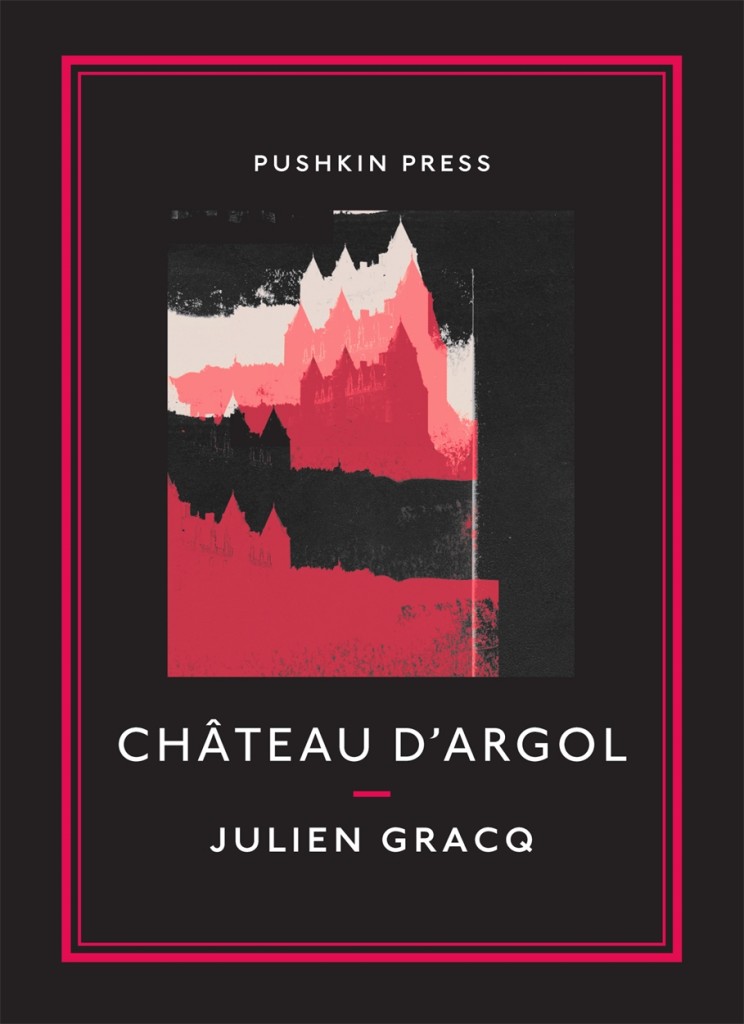
Château D’Argol by Julien Gracq, translated from French by Louise Varèse
Publisher: Pushkin Press, London (2013)
ISBN: 978 1 78227 004 1
The Supernatural Enhancements by Edgar Cantero
Publisher: Doubleday, New York (2014)
ISBN: 978 0 38553 815 2
Like real estate, a Gothic novel is all about location, location, location. Whether it be a Southern Manse, a moldering European castle or a gloomy family estate – success ultimately depends on the setting. Once an author gets that right everything else is up for grabs. Hero or heroine? Truly horrid or amusingly satirical? Supernatural explanations or Scooby Doo ending? No one cares as long as there’s at least one secret passageway.
Published in France in 1938, Julien Gracq’s Château D’Argol was influenced by the late German Romantics (taking as one of its themes the idea that genius is supernatural and unable to exist within societal norms) and the work of Andre Breton (to whom the novel was dedicated). Albert is a wealthy, indolent and arrogant young man – an intellectual who espouses the philosophies of Hegel – who has purchased an isolated medieval castle on the coastline of Brittany. A huge estate surrounded by a dark forest and near the water – Albert spends the beginning of the novella exploring it while he awaits the arrival of his best friend, Herminien.
Herminien, when he arrives, brings with him a beautiful young woman named Heide. Somewhat predictably a love triangle forms between the three. Heide, though, is not the apex of this triangle. Despite a promising start, where she intellectually holds her own with the two friends, she quickly assumes the role of an object to be passed between them. Each man using her as a kind of surrogate for the other. Theirs is the true relationship driving the plot of Château D’Argol. Albert, particularly, is obsessed by his cynical and jaded friend. His interest in Heide no more than an extension of that obsession. Herminian’s motives are harder to place. Heide is one in a long line of lovers – all of whom (according to Albert) are eventually treated cruelly and ridiculed. How Herminian views Albert – the my impression is that Herminian does not possess Albert’s wealth or resources, making his motivations predatory. The result is a dark, disturbing and violent tale.
The nature of the violence obfuscated by the flowery, antiquated language of the prose (reminiscent of William Morris’ work).* Château D’Argol features almost no dialogue. Instead, metaphors saturate Gracq’s writing – descriptions of the landscape providing insight into the characters’ psyches. His repeated reliance on metaphor to create tension can (particularly in today’s world of pared down prose) feel overdone. And yet, in the context of a gothic tale – it works. The metaphors thicken the prose, imbuing it with menace, building layers of foreshadowing. Nature is a harbinger. The paragraph below eventually ends with Albert receiving news of Herminian’s & Heide’s imminent arrival.
The storm was raging over Storrvan. Heavy clouds with jagged edges rushed out of the west, almost brushing against the tower, and at moments enveloping it in streamers of vertiginous white mist. But the wind, above all the wind-filled space with its unbridled and appalling power. Night had almost fallen. The tempest, passing as though through a head of fragile hair, opened quick fugitive furrows through the masses of grey trees, parting them like blades of grass, and for the space of a second one could see the bare soil,black rocks, the narrow fissures of the ravines. Madly the storm twisted this grey mane! Out of it came an immense rustling; the trunks of the trees, before hidden by the frothing leaves, were bared now by the wind’s furious blasts; one could see their frail grey limbs as taught as ship’s rigging. And they yielded, they yielded – a dry crackling was the prelude to the fall, then suddenly a thousand cracklings could be heard, a cascade of resounding noises drowned by the howling of the storm, and the giants were engulfed. Now the shower let loose the icy chill of its deluge like the brutal volley of handfuls of pebbles, and the forest answered with the metallic reverberation of its myriad leaves. Bare rocks glinted like ominous cuirasses, the liquid yellowish splendour of the wet fog crowned for an instant the crest of each forest tree, for an instant a yellow and luminous and marvellously translucid band shone along the horizon against which every branch stood silhouetted, and made the drenched stones of the parapet, Albert’s blond hair soaked by the rain, the cold wet fog rolling around the tops of the trees, shine with a golden gleam, icy and almost inhuman – then went out and night fell like the blow of an axe.
The elaborate style and tangled symbolism is more suited to a 19th century author than to one writing in the 2oth. Gracq’s American contemporaries – Hemingway, Fitzgerald & Faulkner – had all published their modernist masterpieces a decade before.** Joyce’s Finnegans Wake would be released a year later in 1939. Even to readers in 1938, Château D’Argol must have seemed of another age.
_______________________
 The Supernatural Enhancements also can be categorized as a gothic novel. One updated to more suit our modern world. Think Gothic Fusion. Edgar Cantero is a Catalan author who writes in three languages: Spanish, Catalan & English. For this book he chose English and borrows from the idea of the Gothic novel only to quickly abandon it in favor of a DaVinci Code style puzzler.
The initial premise/setting is similar to Château D’Argol in that a young man, referred to only as A., finds himself in possession of a rambling estate. A’s house is located in Virginia, left to him by a distant relative he’s never met. He and his companion/love interest: a punk rock, teenage girl who happens to be mute (I feel as if there should be a more eloquent way to write that, but there you are) travel from Europe to America. They arrive and discover that A.’s relative died under sinister circumstances – by jumping out his third story bedroom window. More distressing is the revelation that this particular mode of suicide runs in the family. The deceased relative’s father also committed suicide in the same way, from the same window… as may have his grandfather (I’m a bit fuzzy on the geneology). Regardless, our two protagonists soon discover that their new home is the meeting place for a secret society. And that a ghost lurks in one of the bathrooms. And that a general curse seems to hang over the place. And if you think I just gave everything away, you couldn’t be more wrong.
The narrative is told through letters, journal entries, video recordings and interviews. Every time you think Cantero has run out of plot twists another one appears. Not always to the good. The Supernatural Enhancements is entertaining at a very superficial level. Cantero introduces so many characters, ideas and strange digressions (the book is a veritable encyclopedia on how to break a code) that when it comes time to wrap up the actual mysteries it feels very hastily done. I half expect there to be a sequel (which I doubt I will read).
The Supernatural Enhancements did make me wonder: what would a true 21st century gothic novel look like? Val McDermid’s redux of Northanger Abbey? Anne Rice’s The Witching Hour (a good, stand-alone book though I found the other two parts of the trilogy unreadable) and Carlos Ruiz Zafon’s The Shadow of the Wind trilogy occurred tome, but are out of the running if only because of the periods they are set in. There needs to be technology included in the plot in a meaningful way and more of a sense of a global world – something Edgar Cantero attempts to incorporate into The Supernatural Enhancements but which is overwhelmed by minutiae. Or is the contemporary gothic novel already here? The purview of the Sci-Fi / Fantasy author?
What do you think, readers – Have you read any good gothic novels lately?
*Gracq referred to Chateau D’Argol as a “demonic” retelling of Percifal. The Grail Legend was a favorite among the Pre-Raphaelites who surrounded Morris. Not to mention influential in Morris’ own writing – particularly his classic fantasy novel The Wood Beyond the World.
**The Sun Also Rises (1926), The Great Gatsby (1925) & The Sound & The Fury (1929).
Krafton: A Nice Place to Visit…
November 17, 2011 § 4 Comments

In the mood for a little American Gothic? Alan Heathcock’s got it. VOLT is a collection of linked short stories charting the history of an isolated, rural community located in an unidentified region. On the surface Krafton is your average small town; there are probably hundreds just like it all across America. But behind closed doors people are dying of unnatural causes, secrets are carefully protected and moral ambiguities abound. The day-to-day lives of Krafton’s citizens are filled with violence and pathos.
If you’re looking for them: Faulkner & McCarthy would be the obvious comparisons to the book Alan Heathcock has created. But Toni Morrison is here, too. (“The Daughter”, in particular, reminds me a lot of Paradise). And Tennessee Williams’ influence can be heard in the dialogue…maybe even a little Steinbeck? Heathcock skips around the 20th century – not only in whom he emulates, but in when he sets his stories. Sometimes the only clue to which decade we’ve landed in is the current war the young men are coming home from. Or not coming home from.
My favorite story is “Peacekeeper”. I kept thinking of William Burroughs’ and the “cut-up technique” he used to write Naked Lunch. Heathcock divides the story into sections, each section headed with a date. It’s all a jumble, moving back and forth between events that take place in December of 2007 and the Spring of 2008. The main character, the peacekeeper of the title, is Krafton’s overworked sheriff Helen Farraley. In the Winter sections she searches for a missing girl. In the Spring there is a flood. The cyclical nature is an appropriate bit of symbolism – the snow that covers the town in Winter melts to become the water that floods it in the Spring. The events of one season have repercussions in the next. The seasons/weather mirrors Helen’s journey. Unfortunately, I can’t tell you much more than that without ruining it.
Helen brought in the oars and the boat glided. Blue sparks fell (from a Roman candle) directly above her. A flashlight beam waggled inside the house. Looters. She drew her pistol and switched on the boat’s spotlight. Inside the room a large long-haired man in black waders spun around. The spotlight threw his shadow on the back wall, and when he shielded his eyes the shadow took the appearance of a hunchback, then grew larger as he ran to the window. He clanged out into the bass boat, the hull rocking and sliding away from the house.
“Danny!” the man screamed, furiously yanking the motor’s cord.
“Stay where you’re at!” Helen yelled.
A candle shot whistled low overhead. Helen ducked, trained the spotlight on the roof. Danny toed the gutter, the wand aimed down at her. She spun off the bench and covered her head. A shot hissed into the water beside the boat.
“This is the police!” Helen yelled.
The other boat’s outboard turned over and raised an octave speeding away. Then another pop, high overhead, and Helen looked to the sky. Golden sparks rained down. Held in an eddy, her boat slowly turning, red sparks fell, and moments later the sky bled green. Then the candle was done and Danny gazed into the whitecaps thrashing the house. He teetered, raised his arms. He leapt from the roof, his legs scissoring as he hit the water.
The writing in VOLT contains powerful and cinematic imagery – a perfect example is the passage above. The author creates a moment of stillness, putting the reader in the revolving boat with Helen staring at the sky. And then Danny hits water and we all snap out of it. Heathcock has a knack for dramatic timing and employs it often to good effect. Close readers won’t be particularly surprised to learn that he’s a huge film buff. Or that he has read up on method acting.*
Like in method acting it’s often a subtle, almost negligent, gesture or a throwaway line that carries the weight of a story. In “Smoke” the gravity of what has occurred – the violent murder of a man – is brought home by the father’s insistence on always respectfully referring to the stranger whom he has brutally beaten to death as Mr. Augusto. There’s psychological implications there to explore. Another line, at the end of “Fort Apache”, had me flipping back to the beginning of that story: “…Put a black boy in that lounge, or one of them Jews, and see how it goes. Don’t care what Lonnie says. Burn a thousand bowling alleys, burn up the whole goddam world, ain’t nothing gonna change”. I realized that we were never told if anyone had been harmed in the fire, or how it started. And though I know it could mean absolutely nothing – that I’m reading too much into it – the possibilities trouble me all the same. Enough to read the story again, searching for anything I might have missed. Alan Heathcock knows how to engage his readers. He feeds their curiosity.
I could keep going on about VOLT for hours. Murder, arson, betrayal, abandonment, destruction of property – it’s all there. But there’s also a flip side. In the title story Helen has to arrest Jorgen Delmore (who’s also the central character in “Furlough”). She meets with Winnie, the Delmore family matriarch. The two women had gone to school together and “run in the same circles”.
Winnie’s face had gone fuller through the cheeks, but her blue eyes, her snaggled smile, were just as Helen remembered.
“How long’s it been?” Winnie asked.
“Too long,” Helen said, and meant it.
Imagine a small, tight- knit community where everyone knows each other and, at the same time, doesn’t know each other. Every family has a story. Every person has a secret. No one is innocent. No one gets out unscathed. That’s life in Krafton… mostly, though, that’s just life. Alan Heathcock has built a world with complexities and contradictions enough to occupy him for years to come. And that, dear readers, is very good news for the rest of us.
VOLT by Alan Heathcock
Publisher: Graywolf Press, Minneapolis (2011).
ISBN: 978 1 55597 577 7
*As I mentioned in my last post, there’s a great Author/Reader Discussion of VOLT going on at The Next Best Book Club (TNBBC) on GoodReads for the month of November. This tidbit of information is shamelessly lifted from Alan’s comments on that forum. I strongly encourage you to go there to learn more.


Nada by Carmen Laforet (translated by Edith Grossman)
January 3, 2011 § 1 Comment
 Nada is a strange novel. I’m not completely sure what to make of it. Spanish literature can often have a labyrinthine quality to it, which isn’t surprising when you remember that Spain gave us Gaudi, Dali & Picasso. It’s a theme picked up by contemporary Spanish authors like Zafon; in films like Pan’s Labyrinth; and in Nada, Carmen Laforet’s award winning 1944 novel – translated by Edith Grossman – where the heroine is continuously wandering the hallways, streets and alleyways of Barcelona. The plot wanders as well. Repeatedly (and abruptly) leading the reader into dead ends.
Andrea, the narrator and heroine of the story, is an orphan. She is plain and sullen. To her, Barcelona is a glamorous city and she’s come there for all the cliché reasons that young people leave their homes in the country to travel to big cities. On her first morning she tells us, “I was in Barcelona. I had heaped too many dreams onto this concrete fact for that first sound of the city not to seem a miracle”. Her plan is to attend university and live with her dead mother’s family. Illusions are quickly brushed aside, though, and the realities of her new life exposed – squalor, petty melodrama and hunger.
Nada is set after the Spanish Civil War in Franco’s Spain. A chasm divides the rich from the poor and Andrea’s family falls in amongst the latter. They live in filth and are slowly starving to death. But the reader get’s the feeling that their poverty is of their own making. The inhabitants of the small apartment on the Calle de Aribau are actors in a macabre, co-dependent drama. Sadistic and manipulative Uncle Roman is the planet around which the others orbit like an astroid belt, colliding and crashing at his amusement. There is crazed Uncle Juan, Gloria his battered wife, and their baby (always on the verge of dying); pious and hypocritical Aunt Augustias; the grotesque maid, Antonia, slavishly devoted to Roman; Andrea’s vague, sweet grandmother. Nada strives to be a Gothic tale. Unfortunately, it never quite achieves the success of its English, 19th Century, counterparts.
It’s not without some charm, though. Which I suppose is what I mean by strangeness – the plot and the writing feels truncated. Edith Grossman may or may not be to blame. This new translation has garnered a lot of praise, but the sentences are too self-contained for my tastes and do not transition smoothly one into the other. I’d like to believe that is what Laforet intended when she wrote them, but there are other, lyrically descriptive passages in this novel that hold the promise of better writing.
“The night seemed splendid, with its breath as warm and pink as blood in a vein opened gently over the street”.
“When it was almost dawn, a cortege of dark clouds, like extremely long fingers, began to float across the sky. At last, they put out the moon.”
“The ships were enormous, their sides extremely high… From some deck, perhaps, Nordic blue eyes would see me as a tiny brushstroke on a foreign print… I, a Spanish girl with dark hair, standing for a moment on a dock in the port of Barcelona. In a few seconds, life would move on, displacing me to some other point. I’d find myself with my body framed by another print…”
At the same time, this choppiness of the rhythm could be defended by a fan of the book. It adds to the disjointed atmosphere of the novel. During the period in which the events she describes take place, Andrea is starving to death. The story she tells us is limited to what she has been told, what she observes and what she imagines. What she knows, we know – no more and no less. All relayed in a narrative voice that is both feverish and rambling. (There is even a portion in which she admits she was slightly delirious and half asleep – hearing the voices of Gloria and her grandmother as she drifts in and out of consciousness). Maybe the tone of the writing sometimes feels dated, but the descriptions are saturated with the colors of the 1930’s and 40’s. Andrea’s life is messy, so why shouldn’t the prose to reflect that?
Did I like Nada? Yes and no, for all the reasons I listed above. Would I read another book by Carmen Laforet? Definitely. Would I recommend Nada to someone else? Maybe. If a friend wanted to borrow it I wouldn’t try to dissuade them or redirect them to another book. But I wouldn’t worry about them returning it either.
Publisher: New York, The Modern Library (2008)
ISBN: 978 0 8129 7583 3


